Products at Nuvantara ↗

The catalogue lives on nuvantara.com — this site sells nothing.

Unreviewed draft. This monograph was prepared editorially with AI assistance and has not yet been signed off by a named expert reviewer. It is published for information and education only, with its sources cited throughout — it is not medical advice. How review works
Monograph · Zingiberaceae

Zingiber cassumunar

Bonglai · Malay   Mengkulai · Malay   Bangle · Javanese   Bangle · Indonesian   Cassumunar ginger · English

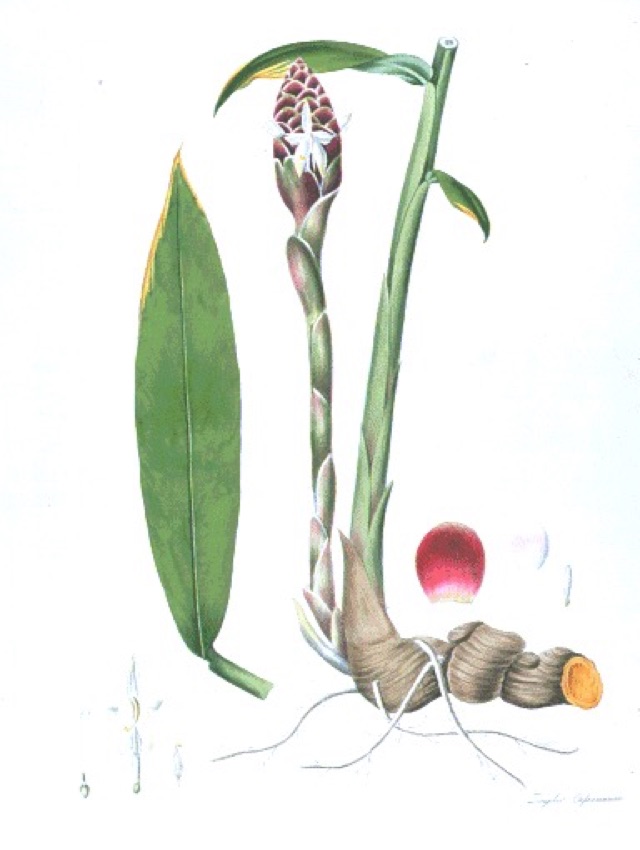
Zingiber cassumunar — botanical illustration
Zingiber cassumunar — from the historical botanical record; see illustration credits on the library page.
Evidence grade
Limited clinical evidence
What the grades mean

Topical preparations of bonglai rhizome carry limited clinical evidence for minor muscle and joint complaints: one double-blind trial of a plai-and-ginger combination gel in knee osteoarthritis and one randomised trial of a plai cream after eccentric exercise, both small, both Thai, and neither independently replicated.

Safety at a glance

Oral toxicity studies are reassuring: Koontongkaew and colleagues (2014) found no treatment-related toxicity at a single 5,000 mg/kg dose in rats and set a 270-day no-observed-adverse-effect level at 1,125 mg/kg/day [7]. Dermal… Full safety section

The evidence ladder
Systematic review ← current position
Clinical studies
Human observational
Preclinical
Laboratory
Phytochemical
Traditional use
Human studies Yes — a 2017 systematic review of six studies (355 patients) supports 14% plai cream for muscle pain and ankle sprain but not other indications; later randomised trials cover diabetic neuropathy and knee osteoarthritis.

The ladder explains the grade; it never replaces it. Evidence for this botanical reaches systematic review, which is why this monograph is graded B.

Traditional use

Bonglai — bangle in Javanese and Indonesian usage, plai in Thailand — is a
rhizome of the massage tradition rather than the kitchen. Jamal and
colleagues' 2011 survey of Malay traditional practitioners records
Zingiber cassumunar among the frequently used species in postnatal care,
a practice built around heated rubs and pastes applied to strained muscle
[1]. The Han 2021 review documents parallel Thai and Indonesian traditional
use of the rhizome for muscle and joint complaints, sprains and swelling
[2]. The regional name-set is worth recording precisely: bonglai and
mengkulai are both current in Malay, and the accepted botanical synonym is
Zingiber montanum.

Phytochemistry

Two chemistries coexist in the rhizome. The essential oil is dominated by
monoterpenes — sabinene and terpinen-4-ol chief among them, characterised
in Indonesian material by Taroeno and colleagues in 1991 [3]. The
non-volatile fraction carries the phenylbutenoids, including compound D
((E)-4-(3,4-dimethoxyphenyl)but-3-en-1-ol) and DMPBD, inventoried in the
Han 2021 review [2]. DMPBD is the best-studied constituent in the
laboratory: Jeenapongsa and colleagues (2003) showed it dose-dependently
reduced experimentally induced ear oedema in rats, outperforming the
standard comparator compounds in that model [4]. DMPBD is also chemically
unstable, which raises real standardisation questions for any commercial
balm.

Evidence review

Two randomised trials anchor the grade. Niempoog and colleagues (2012) ran
a double-blind trial of Plygersic gel — a combination of plai and ginger
(Zingiber officinale) extracts — against 1% diclofenac gel in 100
patients with knee osteoarthritis over six weeks, and reported improved
KOOS scores with no significant difference between the gels [5]. Because
the gel combined two species, the trial cannot isolate bonglai's
contribution. Manimmanakorn and colleagues (2016) randomised 75 volunteers
to 14% or 7% plai cream or placebo, rubbed in after eccentric quadriceps
exercise, measuring soreness, strength, jump height and creatine kinase
over seven days [6] — a single-plant trial, in healthy volunteers rather
than patients.

Both trials are small, short, and from a single country, and no systematic
review meeting our inclusion criteria exists. Evidence for bonglai reaches
early clinical study; the grade remains B until independent replication
with a standardised, single-species preparation is published.

A systematic review published in 2017 gathered six studies covering 355
patients and concluded that a 14% plai cream is supported for muscle pain
and ankle sprain, while other proposed indications are not [8]. Later
randomised work has extended the range without settling it: a
placebo-controlled trial of a 15% balm in painful diabetic neuropathy
reported reduced pain at two and four weeks [9], and a trial in knee
osteoarthritis delivered the extract by phonophoresis [10]. Mechanistic
work continues on the phenylbutenoids that carry the activity [11], and
formulation studies address the skin permeation and stability of compound
D — a practical problem, given the instability noted above [12].

The systematic-review rung is therefore reached. What it found, however,
is limited and indication-specific evidence, which is why the grade sits
at B rather than higher.
Safety & interactions

Oral toxicity studies are reassuring: Koontongkaew and colleagues (2014)
found no treatment-related toxicity at a single 5,000 mg/kg dose in rats
and set a 270-day no-observed-adverse-effect level at 1,125 mg/kg/day [7].
Dermal safety data are thinner than the oral data. Patch-test before use;
do not apply to broken skin; the undiluted essential oil can irritate.
Data in pregnancy are limited — traditional postpartum use notwithstanding,
concentrated extracts deserve professional advice first.

References15
  1. Jamal JA, Abd. Ghafar Z, Husain K (2011). Medicinal plants used for postnatal care in Malay traditional medicine in the Peninsular Malaysia. Pharmacognosy Journal 3(24): 15–24. Source
  2. Han A-R, Kim H, Piao D, Jung C-H, Seo EK (2021). Phytochemicals and bioactivities of Zingiber cassumunar Roxb. Molecules 26(8): 2377. Source
  3. Taroeno, Brophy JJ, Zwaving JH (1991). Analysis of the essential oil of Zingiber cassumunar Roxb. from Indonesia. Flavour and Fragrance Journal 6(2): 161–163. Source
  4. Jeenapongsa R, Yoovathaworn K, Sriwatanakul KM, et al. (2003). Anti-inflammatory activity of (E)-1-(3,4-dimethoxyphenyl)butadiene from Zingiber cassumunar Roxb. Journal of Ethnopharmacology 87(2–3): 143–148. Source
  5. Niempoog S, Siriarchavatana P, Kajsongkram T (2012). The efficacy of Plygersic gel for use in the treatment of osteoarthritis of the knee. Journal of the Medical Association of Thailand 95(Suppl 10): S113–S119. Source
  6. Manimmanakorn N, Manimmanakorn A, Boobphachart D, Thuwakum W, Laupattarakasem W, Hamlin MJ (2016). Effects of Zingiber cassumunar (Plai cream) in the treatment of delayed onset muscle soreness. Journal of Integrative Medicine 14(2): 114–120. Source
  7. Koontongkaew S, et al. (2014). Safety evaluation of Zingiber cassumunar Roxb. rhizome extract: acute and chronic toxicity studies in rats. International Scholarly Research Notices 2014: 632608. Source
  8. Bolhassan R, Bolhassan R, Rozaimie A (2025). Ethnography of irup (jamu): medicinal disclosure of the traditional Malay's midwifery practices in Sarawak. Journal of Borneo-Kalimantan 11(2): 64–77. Source
  9. Julung H, Supiandi MI, Ege B, Zubaidah S, Mahanal S (2024). Zingiberaceae rhizome as traditional medicine based on Dayak Linoh, Malay, and Javanese local wisdom. Tropical Journal of Natural Product Research 8(5): 7232–7243. Source
  10. Chongmelaxme B, Sruamsiri R, Dilokthornsakul P, et al. (2017). Clinical effects of Zingiber cassumunar (Plai): a systematic review. Complementary Therapies in Medicine 35: 70–77. Source
  11. Jatuten N, Piyakunmala P, Budkaew J, Chumworathayi B (2023). Effect of topical Zingiber cassumunar on painful diabetic neuropathy: a double-blind randomized-controlled trial. F1000Research 12: 334. Source
  12. Joshi MV, Phansopkar P (2022). Effect of Zingiber cassumunar Roxb. phonophoresis versus aqua sonic gel on pain, range of motion, and functional disability in patients with osteoarthritis of knee: a randomized controlled trial. Cureus 14(12): e32760. Source
  13. Gundom T, Sukketsiri W, Panichayupakaranant P (2025). Phytochemical analysis and biological effects of Zingiber cassumunar extract and three phenylbutenoids: targeting NF-κB, Akt/MAPK, and caspase-3 pathways. BMC Complementary Medicine and Therapies 25(1): 180. Source
  14. Priprem A, Janpim K, Nualkaew S, Mahakunakorn P (2016). Topical niosome gel of Zingiber cassumunar Roxb. extract for anti-inflammatory activity, enhanced skin permeation and stability of compound D. AAPS PharmSciTech 17(3): 631–639. Source
  15. Kamazeri TS, Samah OA, Taher M, Susanti D, Qaralleh H (2012). Antimicrobial activity and essential oils of Curcuma aeruginosa, Curcuma mangga, and Zingiber cassumunar from Malaysia. Asian Pacific Journal of Tropical Medicine 5(3): 202–209. Source
Open questions4
  • The strongest joint-pain trial tested a plai-and-ginger combination gel; no randomised trial isolates Zingiber cassumunar alone in patients.
  • Both existing trials are small, short and from Thailand; independent replication elsewhere is the open question the grade waits on.
  • Dermal sensitisation and irritation data at balm concentrations are thin, and DMPBD instability raises shelf-life and standardisation questions for commercial products.
  • The 2017 systematic review supports a 14% plai cream for muscle pain and ankle sprain specifically; whether a differently formulated balm inherits that support is untested.