Products at Nuvantara ↗

The catalogue lives on nuvantara.com — this site sells nothing.

Unreviewed draft. This monograph was prepared editorially with AI assistance and has not yet been signed off by a named expert reviewer. It is published for information and education only, with its sources cited throughout — it is not medical advice. How review works
Monograph · Myrtaceae

Psidium guajava

Jambu batu · Malay   Jambu biji · Malay   Jambu klutuk · Javanese   Guava · English

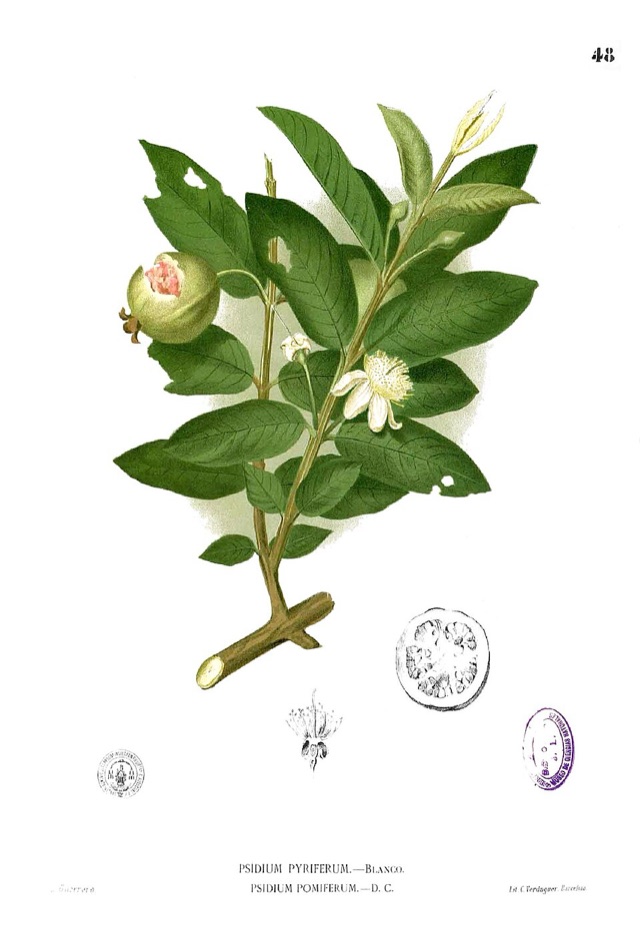
Psidium guajava — botanical illustration
Psidium guajava — from the historical botanical record; see illustration credits on the library page.
Evidence grade
Pre-clinical work or documented traditional use only
What the grades mean

Guava-leaf washes are a documented Malay external remedy, and the modern literature offers a mouse model of eczema-like skin plus human-keratinocyte mechanism work — but no clinical trial of a topical guava-leaf preparation on irritated human skin has been published.

Safety at a glance

Dedicated topical safety studies are lacking; what safety coverage exists sits in the toxicology sections of the major reviews [2, 3], which report wide margins in animal studies of leaf extracts. Tannin-rich decoctions are… Full safety section

The evidence ladder
Systematic review
Clinical studies ← current position
Human observational
Preclinical
Laboratory
Phytochemical
Traditional use
Human studies Yes, but not for skin — a landmark trial of a standardised leaf phytodrug in acute diarrhoea, a randomised pilot in knee pain, and a placebo-controlled mouthrinse trial. No human trial of topical leaf preparations on irritated skin.

The ladder explains the grade; it never replaces it. Evidence for this botanical reaches clinical studies, which is why this monograph is graded C.

Traditional use

The guava tree is grown for its fruit and consulted for its leaves. Ong and
Nordiana's 1999 survey of Malay ethnomedicine in Machang, Kelantan records
jambu biji leaves used externally as a wash on wounds, alongside the better
known oral use for diarrhoea [1]. The Gutiérrez 2008 review assembles the
pan-tropical record, in which topical leaf preparations for skin complaints
recur across continents [2].

Phytochemistry

The leaf is rich in phenolics: flavonoids including quercetin and its
glycosides (guaijaverin, isoquercitrin, hyperoside), catechins, gallic
acid, and a substantial tannin fraction, with a minor essential oil [3].
The preparation matters chemically: the traditional decoction extracts the
water-soluble tannins, while most laboratory studies use solvent extracts
richer in flavonoids — two different chemistries wearing one plant's name.

Evidence review

The most direct evidence is preclinical. Choi and colleagues (2012)
applied a cream containing guava-leaf water extract to
dinitrochlorobenzene-induced eczema-like lesions in NC/Nga mice and
reported lower lesion scores, IgE, TARC and epidermal thickening [4]. Han
and colleagues (2011) showed the extract suppressed the Th2 chemokine
TARC in human keratinocytes via heme oxygenase-1 induction and NF-κB/STAT1
blockade [5] — human cells, but a dish, not a trial. Ojewole (2006)
reported reduced experimentally induced paw swelling and pain responses in
rodents given the aqueous leaf extract [6], and Qa'dan and colleagues
(2005) found the leaf extract inhibited organisms cultured from acne
lesions — an in vitro study on clinical isolates, not a treatment trial
[7].

A consistent preclinical picture, a documented traditional practice, and
no human trial of the topical use: grade C, with the mouse-to-human
translation as the central open question.

Human trials of guava leaf do exist, though none of them tests the use
this monograph describes. The landmark study is a clinical trial of a
standardised leaf phytodrug in acute diarrhoeic disease [10] — the leaf's
headline traditional indication, and the anchor everything since cites. A
randomised, double-blind pilot reported effects of a leaf extract in
Japanese subjects with knee pain [11], and a placebo-controlled trial
tested a guava-leaf mouthrinse as part of an oral-care regimen [12]. A
topical formulation has been studied for thermoregulatory effect after
exercise [13]. A 2024 review synthesises the antidiarrhoeal literature
across forty-four countries and maps it onto the identified bioactives
[14].

So the ladder reaches the clinical rung for the leaf — but for the gut and
the mouth, not for irritated skin. The grade stays at C because the
question this entry asks remains untested in humans.
Safety & interactions

Dedicated topical safety studies are lacking; what safety coverage exists
sits in the toxicology sections of the major reviews [2, 3], which report
wide margins in animal studies of leaf extracts. Tannin-rich decoctions
are astringent and can dry or temporarily stain skin with repeated use.
No patch-test data exist for leaf preparations on compromised skin, so
the practical advice is the usual: patch-test first, stop on irritation,
and keep diagnosed skin conditions under clinical care.

References19
  1. Ong HC, Nordiana M (1999). Malay ethno-medico botany in Machang, Kelantan, Malaysia. Fitoterapia 70(5): 502–513. Source
  2. Gutiérrez RMP, Mitchell S, Solis RV (2008). Psidium guajava: a review of its traditional uses, phytochemistry and pharmacology. Journal of Ethnopharmacology 117(1): 1–27. Source
  3. Díaz-de-Cerio E, Verardo V, Gómez-Caravaca AM, Fernández-Gutiérrez A, Segura-Carretero A (2017). Health effects of Psidium guajava L. leaves: an overview of the last decade. International Journal of Molecular Sciences 18(4): 897. Source
  4. Choi JH, Park BH, Kim HG, Hwang YP, Han EH, Jin SW, Seo JK, Chung YC, Jeong HG (2012). Inhibitory effect of Psidium guajava water extract in the development of 2,4-dinitrochlorobenzene-induced atopic dermatitis in NC/Nga mice. Food and Chemical Toxicology 50(8): 2923–2929. Source
  5. Han EH, Hwang YP, Choi JH, Yang JH, Seo JK, Chung YC, Jeong HG (2011). Psidium guajava extract inhibits thymus and activation-regulated chemokine (TARC/CCL17) production in human keratinocytes by inducing heme oxygenase-1 and blocking NF-κB and STAT1 activation. Environmental Toxicology and Pharmacology 32(2): 136–145. Source
  6. Ojewole JAO (2006). Antiinflammatory and analgesic effects of Psidium guajava Linn. (Myrtaceae) leaf aqueous extract in rats and mice. Methods and Findings in Experimental and Clinical Pharmacology 28(7): 441–446. Source
  7. Qa'dan F, Thewaini AJ, Ali DA, Afifi R, Elkhawad A, Matalka KZ (2005). The antimicrobial activities of Psidium guajava and Juglans regia leaf extracts to acne-developing organisms. American Journal of Chinese Medicine 33(2): 197–204. Source
  8. Ong HC, Ruzalila BN, Milow P (2011). Traditional knowledge of medicinal plants among the Malay villagers in Kampung Tanjung Sabtu, Terengganu, Malaysia. Indian Journal of Traditional Knowledge 10(3): 460–465. Source
  9. Panjaitan RGP, Kurniasi A, Wahyuni ES, et al. (2025). Medicinal plants for digestive system disorders in Tebing Batu Village, Sambas District, West Kalimantan, Indonesia. Biodiversitas 26(11): 5647–5658. Source
  10. Ramli MR, Malek S, Milow P, Aziz NJ (2021). Traditional knowledge of medicinal plants in the Kampung Orang Asli Donglai Baru, Hulu Langat, Malaysia. Biodiversitas 22(3): 1304–1309. Source
  11. Bachok MF, Mohd Yusof BN, Ismail A, Abdul Hamid A (2014). Effectiveness of traditional Malaysian vegetables (ulam) in modulating blood glucose levels. Asia Pacific Journal of Clinical Nutrition 23(3): 369–376. Source
  12. Liu C, Jullian V, Chassagne F (2024). Ethnobotany, phytochemistry, and biological activities of Psidium guajava in the treatment of diarrhea: a review. Frontiers in Pharmacology 15: 1459066. Source
  13. Kumar M, Tomar M, Amarowicz R, et al. (2021). Guava (Psidium guajava L.) leaves: nutritional composition, phytochemical profile, and health-promoting bioactivities. Foods 10(4): 752. Source
  14. Huynh HD, Nargotra P, Wang HD, Shieh CJ, Liu YC, Kuo CH (2025). Bioactive compounds from guava leaves (Psidium guajava L.): characterization, biological activity, synergistic effects, and technological applications. Molecules 30(6): 1278. Source
  15. Kakuo S, Fushimi T, Kawasaki K, Nakamura J, Ota N (2018). Effects of Psidium guajava Linn. leaf extract in Japanese subjects with knee pain: a randomized, double-blind, placebo-controlled, parallel pilot study. Aging Clinical and Experimental Research 30(11): 1391–1398. Source
  16. Nayak N, Varghese J, Shetty S, et al. (2019). Evaluation of a mouthrinse containing guava leaf extract as part of comprehensive oral care regimen — a randomized placebo-controlled clinical trial. BMC Complementary and Alternative Medicine 19(1): 327. Source
  17. Wongsanao T, Leemingsawat W, Panapisal V, Kritpet T (2021). Thermoregulatory effects of guava leaf extract-menthol toner application for post-exercise use. Pharmaceutical Biology 59(1): 852–857. Source
  18. Lozoya X, Reyes-Morales H, Chávez-Soto MA, et al. (2002). Intestinal anti-spasmodic effect of a phytodrug of Psidium guajava folia in the treatment of acute diarrheic disease. Journal of Ethnopharmacology 83(1–2): 19–24. Source
  19. Ishak SA, Ariffin N, Azmi FF (2024). Kesan ekstrak daun jambu batu (Psidium guajava) terhadap eritrosit terinfeksi Plasmodium berghei NK65. Sains Malaysiana 53(4): 869–880. Source
Open questions3
  • No clinical trial of a topical guava-leaf preparation on irritated human skin exists; whether the mouse and keratinocyte findings translate is untested.
  • Traditional decoctions and laboratory solvent extracts have different chemistries — tannin-dominant versus flavonoid-rich — and activity may not transfer between formats.
  • Contact-sensitisation potential of tannin-rich leaf preparations on already-compromised skin has not been formally tested.