Products at Nuvantara ↗

The catalogue lives on nuvantara.com — this site sells nothing.

Unreviewed draft. This monograph was prepared editorially with AI assistance and has not yet been signed off by a named expert reviewer. It is published for information and education only, with its sources cited throughout — it is not medical advice. How review works
Monograph · Zingiberaceae

Curcuma longa

Kunyit · Malay   Kunir · Javanese   Kunyit · Indonesian   Turmeric · English

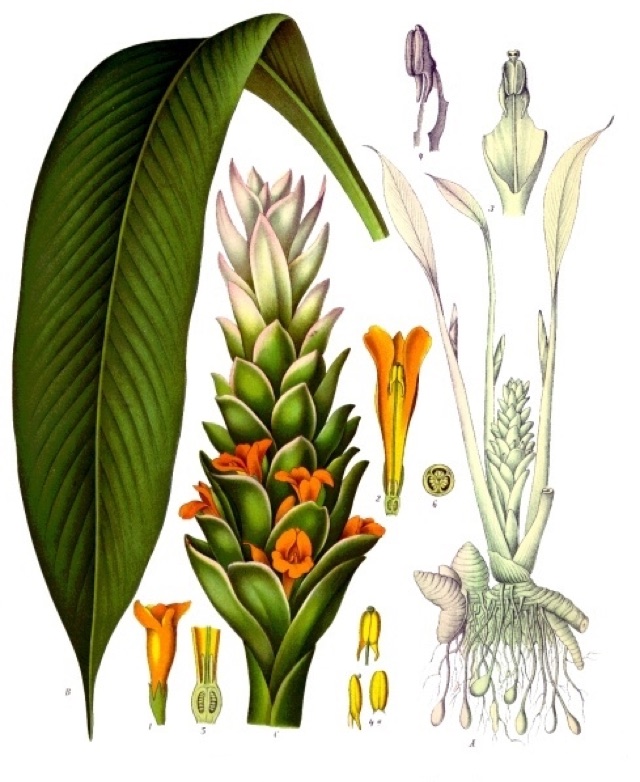
Curcuma longa — botanical illustration
Curcuma longa — from the historical botanical record; see illustration credits on the library page.
Evidence grade
Limited clinical evidence
What the grades mean

Oral standardised turmeric extract carries limited clinical evidence in knee osteoarthritis — two randomised trials against ibuprofen and a 2016 meta-analysis — but every trial used oral extract at gram doses, not the topical warming pastes of Malay tradition, whose efficacy remains untested.

Safety at a glance

Turmeric has an exceptionally long record of dietary use. The Soleimani 2018 safety review reports oral curcumin tolerated at doses up to 6 g/day over several weeks in human studies, with gastrointestinal upset the main complaint… Full safety section

The evidence ladder
Systematic review ← current position
Clinical studies
Human observational
Preclinical
Laboratory
Phytochemical
Traditional use
Human studies Yes, for oral extract — multiple randomised trials in knee osteoarthritis and several meta-analyses, including a 2025 network meta-analysis. None for the topical param preparations this monograph describes.

The ladder explains the grade; it never replaces it. Evidence for this botanical reaches systematic review, which is why this monograph is graded B.

Traditional use

Kunyit is the kitchen's botanical before it is the healer's: the rhizome
colours and seasons the everyday Malay table, and the same fresh-pounded
paste appears in the region's body-care tradition — most visibly in the
postpartum param, the warming paste applied during confinement. Jamal and
colleagues' 2011 survey of Malay traditional practitioners in Peninsular
Malaysia records Curcuma longa among the most frequently used species in
postnatal care, including topical preparations [1]. The wider Javanese jamu
tradition uses turmeric species in comparable mixtures, documented for
Curcuma xanthorrhiza (temulawak) alongside C. longa [2] — corroborating
context for the practice rather than evidence for this species alone.

Phytochemistry

The rhizome's colour and most of its studied pharmacology belong to the
curcuminoids — curcumin, demethoxycurcumin and bisdemethoxycurcumin — with
a volatile oil fraction dominated by sesquiterpenes such as ar-turmerone
[3]. Curcumin's poor oral bioavailability is one of the field's central
complications: the clinical trials below used standardised extracts at
gram-per-day doses, and their results cannot be assumed to transfer to
culinary quantities — or across the skin from a paste.

Evidence review

The clinical evidence sits with the oral extract. Kuptniratsaikul and
colleagues (2009) randomised 107 patients with knee osteoarthritis to
Curcuma domestica (= C. longa) extract at 2 g/day or ibuprofen for six
weeks and reported similar improvement in both arms [4]. The same group's
2014 multicentre trial (n=367) found the extract at 1,500 mg/day
non-inferior to ibuprofen on WOMAC scores over four weeks, with fewer
gastrointestinal complaints [5]. Daily and colleagues' 2016 meta-analysis
of randomised trials concluded that around 1,000 mg/day of curcumin
relieved arthritis symptoms, while stating that the number and quality of
trials was insufficient for definitive conclusions [6].

That last sentence is why this entry is B rather than A — and one caveat
matters more than any of it: the traditional preparation this monograph
describes is a warming paste on the skin, and no randomised trial of a
topical param-style preparation has been published. The oral evidence
establishes that the plant's chemistry is clinically interesting; it does
not validate the traditional format.

Since that meta-analysis the picture has been refined rather than
overturned. A dose-stratified meta-analysis of eleven randomised trials
(n=1,258) examined high- and low-dose curcumin against pain and function
scores [8]; a Bayesian network meta-analysis compared curcuminoid
formulations with NSAIDs and placebo [9]; and a 2025 network meta-analysis
ranked turmeric preparations for knee osteoarthritis [10]. A 2025 umbrella
appraisal of these reviews is candid that their methodological quality
varies [11]. None of this changes the central caveat: every trial used oral
extract at gram doses, and the traditional preparation described above is a
paste on the skin.
Safety & interactions

Turmeric has an exceptionally long record of dietary use. The Soleimani
2018 safety review reports oral curcumin tolerated at doses up to 6 g/day
over several weeks in human studies, with gastrointestinal upset the main
complaint [7]. On skin, fresh turmeric paste stains and can irritate
sensitised individuals; patch-test before applying a concentrated
preparation. High-dose extracts are best avoided in pregnancy and alongside
anticoagulant medication without professional advice, and gallbladder
disease is a recorded caution for concentrated oral extract.

One signal has strengthened since the older safety reviews and belongs in
any current assessment. The US Drug-Induced Liver Injury Network published
ten adjudicated cases of turmeric-associated liver injury, with the
HLA-B*35:01 allele identified as a susceptibility marker [12]. A
subsequent United States Pharmacopeia expert review concluded such cases
are rare and related to dose and to enhanced-bioavailability formulations,
while recommending a cautionary statement in the monograph [13]. The
practical reading: culinary kunyit and topical paste are not the concern;
concentrated high-bioavailability oral supplements are. Malaysian
hospital-based work has separately flagged peripartum herbal ingestion as
warranting clinical attention [14].

References17
  1. Jamal JA, Abd. Ghafar Z, Husain K (2011). Medicinal plants used for postnatal care in Malay traditional medicine in the Peninsular Malaysia. Pharmacognosy Journal 3(24): 15–24. Source
  2. Rahmat E, Lee J, Kang Y (2021). Javanese turmeric (Curcuma xanthorrhiza Roxb.): ethnobotany, phytochemistry, biotechnology, and pharmacological activities. Evidence-Based Complementary and Alternative Medicine 2021: 9960813. Source
  3. Iweala EJ, Uche ME, Dike ED, Etumnu LR, Dokunmu TM, Oluwapelumi AE, et al. (2023). Curcuma longa (turmeric): ethnomedicinal uses, phytochemistry, pharmacological activities and toxicity profiles — a review. Pharmacological Research — Modern Chinese Medicine 6: 100222. Source
  4. Kuptniratsaikul V, Thanakhumtorn S, Chinswangwatanakul P, Wattanamongkonsil L, Thamlikitkul V (2009). Efficacy and safety of Curcuma domestica extracts in patients with knee osteoarthritis. Journal of Alternative and Complementary Medicine 15(8): 891–897. Source
  5. Kuptniratsaikul V, Dajpratham P, Taechaarpornkul W, et al. (2014). Efficacy and safety of Curcuma domestica extracts compared with ibuprofen in patients with knee osteoarthritis: a multicenter study. Clinical Interventions in Aging 9: 451–458. Source
  6. Daily JW, Yang M, Park S (2016). Efficacy of turmeric extracts and curcumin for alleviating the symptoms of joint arthritis: a systematic review and meta-analysis of randomized clinical trials. Journal of Medicinal Food 19(8): 717–729. Source
  7. Soleimani V, Sahebkar A, Hosseinzadeh H (2018). Turmeric (Curcuma longa) and its major constituent (curcumin) as nontoxic and safe substances: review. Phytotherapy Research 32(6): 985–995. Source
  8. Tengku Mohamad TAS, Islahudin F, Jasamai M, Jamal JA (2022). Traditional practitioner's knowledge of Malay post-partum herbal remedies in Malaysia. Archives of Pharmacy Practice 13(2): 11–16. Source
  9. Fadzil F, Shamsuddin K, Wan Puteh SE (2016). Traditional postpartum practices among Malaysian mothers: a review. Journal of Alternative and Complementary Medicine 22(7): 503–508. Source
  10. Ridzuan MH, Ali MF, Tan CE, Abdul Aziz AF (2021). Traditional and complementary medicine use during postpartum period: a cross-sectional analysis at a rural, public maternal and child health clinic in West Malaysia. Cureus 13(6): e15410. Source
  11. Julung H, Supiandi MI, Ege B, Zubaidah S, Mahanal S (2024). Zingiberaceae rhizome as traditional medicine based on Dayak Linoh, Malay, and Javanese local wisdom. Tropical Journal of Natural Product Research 8(5): 7232–7243. Source
  12. Wai HS, Pathomwichaiwat T, Suansanae T, Nathisuwan S, Rattanavipanon W (2025). Effect of turmeric products on knee osteoarthritis: a systematic review and network meta-analysis. BMC Complementary Medicine and Therapies 25(1): 292. Source
  13. Zhao J, Liang G, Zhou G, Hong K, Yang W, Liu J, Zeng L (2024). Efficacy and safety of curcumin therapy for knee osteoarthritis: a Bayesian network meta-analysis. Journal of Ethnopharmacology 321: 117493. Source
  14. Hsiao AF, Lien YC, Tzeng IS, Liu CT, Chou SH, Horng YS (2021). The efficacy of high- and low-dose curcumin in knee osteoarthritis: a systematic review and meta-analysis. Complementary Therapies in Medicine 63: 102775. Source
  15. Halegoua-DeMarzio D, Navarro V, Ahmad J, et al. (2023). Liver injury associated with turmeric — a growing problem: ten cases from the Drug-Induced Liver Injury Network (DILIN). The American Journal of Medicine 136(2): 200–206. Source
  16. Akhtar N, Barnes J, Gardiner P, et al. (2026). Rarely reported cases of hepatotoxicity associated with turmeric- and curcuminoid-containing dietary supplements: a comprehensive review by USP. Pharmaceutical Biology 64(1): 866–901. Source
  17. Teoh CS, et al. (2013). Herbal ingestion during pregnancy and post-partum period is a cause for concern. Medical Journal of Malaysia 68(2): 157–160. Source
Open questions5
  • No clinical trial tests a topical turmeric warming paste on joints; curcuminoid penetration through skin from a crude paste is unquantified.
  • Whether the warming sensory effect of param preparations contributes measurable benefit beyond counter-irritation and massage is untested.
  • Trial results with standardised gram-dose oral extracts may not extrapolate to culinary-grade kunyit; the dose–response relationship at traditional intakes is unknown.
  • Does the hepatotoxicity signal reported for concentrated, enhanced-bioavailability oral curcumin extend in any degree to traditional culinary or topical use? The published cases do not suggest it, but no study addresses the question directly.
  • The ladder now reaches systematic review on the strength of the oral osteoarthritis meta-analyses; whether the grade should follow is a reviewer judgement, since none of that evidence concerns the topical preparation this monograph describes.