The catalogue lives on nuvantara.com — this site sells nothing.
Unreviewed draft. This monograph was prepared editorially with AI assistance and has not yet been signed off by a named expert reviewer. It is published for information and education only, with its sources cited throughout — it is not medical advice. How review works
Monograph · Rubiaceae
Morinda citrifolia
Mengkudu· Malay Pace· Javanese Mengkudu· Indonesian Noni· English
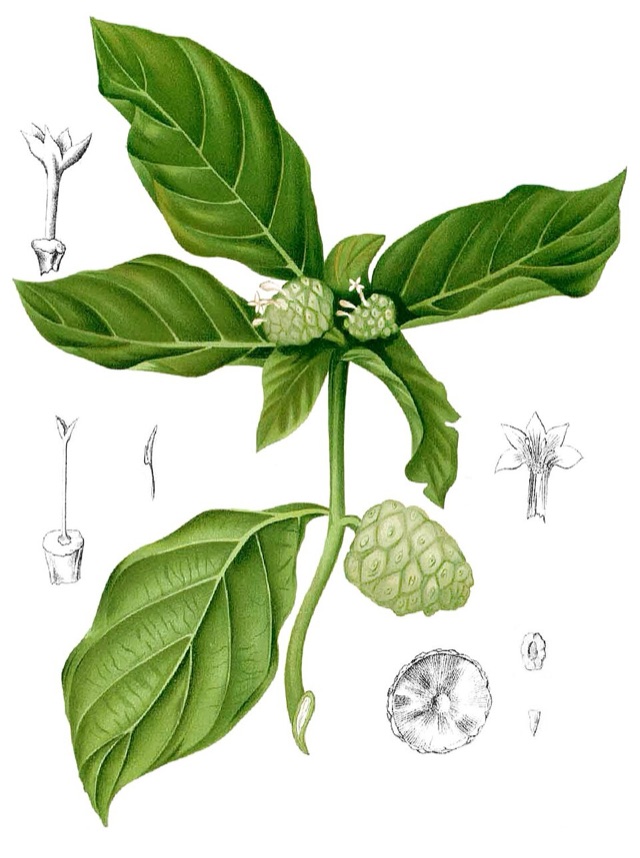
Morinda citrifolia — from the historical botanical record; see illustration credits on the library page.
C
Evidence grade
Pre-clinical work or documented traditional use only
StatusUnreviewed draft — pending expert review; not medical advice
The heated mengkudu leaf is a documented topical remedy across the Malay world and the Pacific; the modern literature offers rodent wound-model work and solid leaf-specific safety data, but no human study of the poultice practice itself.
Safety at a glance
The leaf is one of the better-characterised botanicals in this library
for safety, because European novel-food regulation demanded it: the EFSA
panel assessed dried and roasted mengkudu leaves for infusions and set an
intake… Full safety section
The evidence ladder
Systematic review
Clinical studies
Human observational
Preclinical← current position
Laboratory
Phytochemical
Traditional use
Human studiesNone for the leaf. The human literature on Morinda citrifolia concerns the fruit or fruit juice, which this monograph excludes.
The ladder explains the grade; it never replaces it. Evidence for this botanical reaches preclinical, which is why this monograph is graded C.
Traditional use
Long before noni juice reached the health-food shelf, the mengkudu tree's
leaves were the working part of the plant. McClatchey's 2002 historical
review documents that traditional Polynesian indications centred on
leaves, roots and bark applied topically — and that the fruit-juice
framing is a modern commercial invention [1]. The heated-leaf poultice —
the leaf warmed over a flame and pressed to boils, bites and swellings —
is recorded across the region's practice [2]. This monograph is about the
leaf; the fruit literature is out of its scope and, as the Safety section
notes, must not be conflated with it.
Phytochemistry
The leaf's chemistry is distinct from the fruit's: flavonoids (kaempferol,
rutin), iridoids of the asperuloside series with aucubin, and coumarins
including scopoletin, surveyed in recent reviews [2, 3], with early
leaf-specific glycoside work by Sang and colleagues [4]. What heating over
a flame — the defining step of the traditional preparation — does to those
constituents has never been characterised.
Evidence review
The leaf's laboratory record includes one directly relevant animal study:
Nayak and colleagues (2009) gave ethanolic leaf extract in rat excision
and dead-space wound models and reported 71% wound-area reduction by day
11 against 57% in controls [5]. That is wound closure in rodents — not
insect bites, not histamine response, not humans.
Nothing in the verified literature tests the poultice practice itself: no
human study of heated mengkudu leaf on bites or minor skin complaints
exists. The traditional record is strong, the leaf's safety data are
unusually good for this library (below), and the clinical question is
completely open. Grade C.
Safety & interactions
The leaf is one of the better-characterised botanicals in this library
for safety, because European novel-food regulation demanded it: the EFSA
panel assessed dried and roasted mengkudu leaves for infusions and set an
intake ceiling of 18.4 mg/kg body weight per day [6], and West and
colleagues (2007) reported negative acute, subacute and subchronic
toxicity and anaphylaxis testing for leaf extracts [7]. The widely cited
hepatotoxicity case reports concern noni fruit juice, not the leaf [8],
and a head-to-head chronic study in mice found toxicity signals with
high-dose fruit extract while leaf extracts showed none [9]. A bite that
is spreading, blistering or systemically unwell needs clinical care, not
a poultice.
A systematic review from the Herbal Medicine Research Centre at Malaysia's
Institute for Medical Research assessed both efficacy and safety across the
noni literature [10] — a useful regulatory-adjacent reference precisely
because it does not overstate. Separate Malaysian work on the leaf reports
performance and vascular effects in animal models without the toxicity
signals associated with high-dose fruit extract [11, 12].
References20
McClatchey W (2002). From Polynesian healers to health food stores: changing perspectives of Morinda citrifolia (Rubiaceae). Integrative Cancer Therapies 1(2): 110–120. Source
Nascimento Junior JAC, Santos AM, Oliveira AMS, et al. (2025). Botany, ethnomedicinal uses, biological activities, phytochemistry, and technological applications of Morinda citrifolia plants. Molecules 30(18): 3831. Source
Hou S, Ma J, Wu X, Hui H, Hao J (2025). Morinda citrifolia L.: a comprehensive review on phytochemistry, pharmacological effects, and antioxidant potential. Antioxidants 14(3): 295. Source
Sang S, et al. (2002). Chemical components in noni fruits and leaves (Morinda citrifolia L.). ACS Symposium Series 803: 134–150. Source
Nayak BS, et al. (2009). Evaluation of the wound-healing activity of ethanolic extract of Morinda citrifolia L. leaf. Evidence-Based Complementary and Alternative Medicine 6(3): 351–356. Source
EFSA NDA Panel (2008). Safety of 'leaves from Morinda citrifolia L.' — scientific opinion of the Panel on Dietetic Products, Nutrition and Allergies. EFSA Journal 769: 1–17. Source
West BJ, et al. (2007). Safety tests and antinutrient analyses of noni (Morinda citrifolia L.) leaf. Journal of the Science of Food and Agriculture 87(14): 2583–2588. Source
Stadlbauer V, et al. (2005). Hepatotoxicity of NONI juice: report of two cases. World Journal of Gastroenterology 11(30): 4758–4760. Source
Mohamad Shalan NAA, Mustapha NM, Mohamed S (2017). Chronic toxicity evaluation of Morinda citrifolia fruit and leaf in mice. Regulatory Toxicology and Pharmacology 83: 46–53. Source
Ahmad Lutfil Hadi Z, Nurshahidah MR, Ismail R, et al. (2025). Diversity of medicinal plants in the practice of bertungku among Malay traditional practitioners (MTPs) in Peninsular Malaysia. Journal of Tropical Forest Science 37(Special Issue): 41–47. Source
Tengku Mohamad TAS, Islahudin F, Jasamai M, Jamal JA (2022). Traditional practitioner's knowledge of Malay post-partum herbal remedies in Malaysia. Archives of Pharmacy Practice 13(2): 11–16. Source
Othman R, Khiruddin SA (2018). Landscape ethnobotanical study of Malay midwifery plant species: case study of Kelantan. Journal of Architecture, Planning & Construction Management 8(1): 47–54. Source
Samuel AJ, Kalusalingam A, Chellappan DK, et al. (2010). Ethnomedical survey of plants used by the Orang Asli in Kampung Bawong, Perak, West Malaysia. Journal of Ethnobiology and Ethnomedicine 6: 5. Source
Nelson SC (2006). Morinda citrifolia (noni). In: Elevitch CR (ed.) Species Profiles for Pacific Island Agroforestry, ver. 4. Permanent Agriculture Resources. Source
Nascimento Júnior JAC, Santos AM, Oliveira AMS, et al. (2025). Botany, ethnomedicinal uses, biological activities, phytochemistry, and technological applications of Morinda citrifolia plants. Molecules 30(18): 3831. Source
Torres MAO, de Fátima Braga Magalhães I, Mondêgo-Oliveira R, de Sá JC, Rocha AL, Abreu-Silva AL (2017). One plant, many uses: a review of the pharmacological applications of Morinda citrifolia. Phytotherapy Research 31(7): 971–979. Source
Serafini MR, Santos RC, Guimarães AG, et al. (2011). Morinda citrifolia Linn leaf extract possesses antioxidant activities and reduces nociceptive behavior and leukocyte migration. Journal of Medicinal Food 14(10): 1159–1166. Source
Chong CLG, Othman F, Hussan F (2018). Vascular protective effects of Morinda citrifolia leaf extract on postmenopausal rats fed with thermoxidized palm oil diet: evidence at microscopic level. International Journal of Vascular Medicine 2018: 6317434. Source
Mohamad Shalan NA, Mustapha NM, Mohamed S (2016). Morinda citrifolia leaf enhanced performance by improving angiogenesis, mitochondrial biogenesis, antioxidant, anti-inflammatory and stress responses. Food Chemistry 212: 443–452. Source
Chanthira Kumar H, Lim XY, Mohkiar FH, Suhaimi SN, Mohammad Shafie N, Chin Tan TY (2022). Efficacy and safety of Morinda citrifolia L. (noni) as a potential anticancer agent. Integrative Cancer Therapies 21: 15347354221132848. Source
Open questions3
No human study tests noni leaf poultices for insect bites or minor wounds; the traditional practice itself has never been formally trialled.
The traditional heating step is chemically uncharacterised — whether it degrades or liberates the relevant leaf constituents is unknown.
Bite-site specificity is undemonstrated: the animal literature addresses excision wounds, not envenomation, histamine response or bite-site infection.