The catalogue lives on nuvantara.com — this site sells nothing.
Unreviewed draft. This monograph was prepared editorially with AI assistance and has not yet been signed off by a named expert reviewer. It is published for information and education only, with its sources cited throughout — it is not medical advice. How review works
Monograph · Piperaceae
Piper betle
Sireh· Malay Daun sirih· Indonesian Betel leaf· English
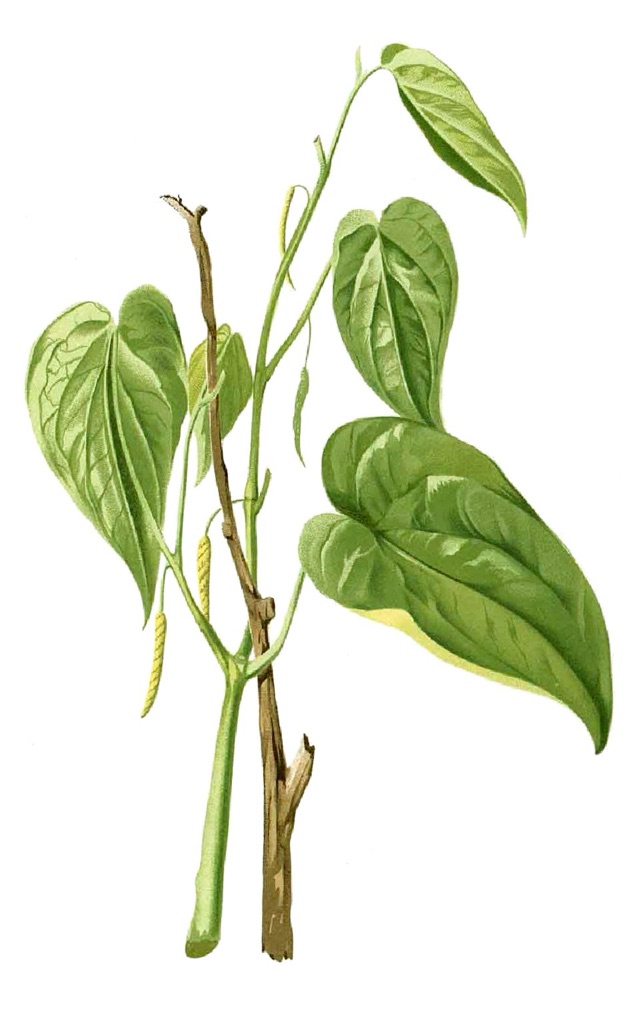
Piper betle — from the historical botanical record; see illustration credits on the library page.
C
Evidence grade
Pre-clinical work or documented traditional use only
StatusUnreviewed draft — pending expert review; not medical advice
The sireh leaf's reputation against microbes has a substantial laboratory literature centred on hydroxychavicol, and one small mouthwash trial; no controlled human study tests the leaf in the topical and hygiene uses Malay tradition actually records.
Safety at a glance
The essential distinction: the International Agency for Research on Cancer
classifies betel quid — with or without tobacco — and areca nut as Group 1
carcinogens [8]. That evaluation attaches to the quid preparation with
Areca… Full safety section
The evidence ladder
Systematic review
Clinical studies← current position
Human observational
Preclinical
Laboratory
Phytochemical
Traditional use
Human studiesTwo small trials of leaf preparations, both in oral care — a post-debridement mouthwash trial and a crossover trial of a betel-leaf dentifrice. None for the skin and hygiene uses the Malay record describes.
The ladder explains the grade; it never replaces it. Evidence for this botanical reaches clinical studies, which is why this monograph is graded C.
Traditional use
Few plants sit deeper in Malay material culture than sireh. Zamri and
colleagues' 2023 scoping review traces the leaf through Malay medical
manuscripts — recorded for conditions associated with infection, menstrual
complaints and postpartum care — and bridges the manuscript record to the
modern laboratory literature [1]. The leaf's ceremonial and social life,
from kunyah sireh onward, is documented alongside its household uses as a
wash and compress [2]. One disambiguation matters and this monograph makes
it early: sireh the leaf is not the betel quid. The quid — areca nut and
lime, wrapped in the leaf — is a different preparation with its own grave
safety literature, addressed under Safety below.
Phytochemistry
The leaf's most studied constituent is hydroxychavicol, alongside
chavibetol, eugenol, chavicol and allylpyrocatechol [2]. Hydroxychavicol
carries most of the laboratory record: Sharma and colleagues (2009)
reported minimum inhibitory concentrations of 62.5–500 µg/ml against oral
organisms, activity against Streptococcus mutans biofilm, and a
post-exposure suppression effect of six to seven hours [3]. Singh and
colleagues (2018) traced a mechanism — reactive-oxygen-mediated DNA damage
and division arrest in Escherichia coli[4].
Evidence review
The in vitro record is broad. Beyond the work above, Ali and colleagues
(2010) screened hydroxychavicol against 124 fungal strains and reported
minimum inhibitory concentrations of 7.81–62.5 µg/ml against dermatophytes
and 15.62–500 µg/ml against yeasts, with activity against Candida
biofilm [5]; a Malaysian group reported combination effects of
hydroxychavicol with amphotericin B against oral Candida species [6].
Human evidence is one small trial in a different setting: Sundaram and
colleagues (2021) randomised 60 periodontitis patients to a piper-extract
mouthwash or chlorhexidine after debridement and reported comparable
reduction of Porphyromonas gingivalis[7]. It is small, single-site, and
an oral rinse — not the skin and hygiene uses of the Malay record. The
laboratory case is genuinely strong for a grade C; the clinical case has
barely begun.
A second human trial has since been published in the same domain: a
randomised crossover study in sixty participants with mild gingivitis
found a betel-leaf dentifrice reduced gingival bleeding more than the
comparator over twenty days [9]. A 2021 review gathers the antimicrobial
literature — bacterial and fungal — together with a safety-profile section for the
leaf specifically [10], and Malaysian work has examined the leaf extract
in other models entirely [11].
Two small oral-care trials move the ladder to the clinical rung. They do
not touch the skin and hygiene uses the Malay record actually describes,
which is why the grade stays at C.
Safety & interactions
The essential distinction: the International Agency for Research on Cancer
classifies betel quid — with or without tobacco — and areca nut as Group 1
carcinogens [8]. That evaluation attaches to the quid preparation with Areca catechu, not to Piper betle leaf alone, which was not the
evaluated agent; the honest statement is "not the evaluated agent," never
"shown safe." Eugenol, present in the leaf, is a recognised contact
allergen, and the long-term mucosal safety of repeated topical leaf
exposure is uncharacterised. Patch-test before use; discontinue on
irritation.
References17
Zamri NFI, et al. (2023). A scoping review on medicinal properties of Piper betle (sirih) based on Malay medical manuscripts and scientific literatures. Malaysian Journal of Medical Sciences 30(5): 23–39. Source
Biswas P, et al. (2022). Betelvine (Piper betle L.): a comprehensive insight into its ethnopharmacology, phytochemistry, and pharmacological, biomedical and therapeutic attributes. Journal of Cellular and Molecular Medicine 26(11): 3083–3119. Source
Sharma S, et al. (2009). Evaluation of the antimicrobial, antioxidant, and anti-inflammatory activities of hydroxychavicol for its potential use as an oral care agent. Antimicrobial Agents and Chemotherapy 53(1): 216–222. Source
Singh D, et al. (2018). Hydroxychavicol, a key ingredient of Piper betle induces bacterial cell death by DNA damage and inhibition of cell division. Free Radical Biology and Medicine 120: 62–71. Source
Ali I, et al. (2010). In vitro antifungal activity of hydroxychavicol isolated from Piper betle L. Annals of Clinical Microbiology and Antimicrobials 9: 7. Source
Himratul-Aznita WH, Mohd-Al-Faisal N, Fathilah AR (2016). Antifungal activity of dual combination of hydroxychavicol with commercialized agents against oral Candida species. SpringerPlus 5: 1696. Source
Sundaram G, et al. (2021). Effect of piper extract mouthwash as postprocedural rinse on levels of Porphyromonas gingivalis in periodontitis patients. Journal of Indian Society of Periodontology 25(5): 418–421. Source
IARC Working Group (2004). Betel-quid and areca-nut chewing and some areca-nut-derived nitrosamines. IARC Monographs on the Evaluation of Carcinogenic Risks to Humans, Vol. 85. Lyon: IARC. Source
Salleh N (2014). Tepak sirih: komunikasi bukan lisan dalam adat perkahwinan Melayu. Jurnal Komunikasi / Malaysian Journal of Communication 30(Special Issue): 177–190. Source
Othman R, Khiruddin SA (2018). Landscape ethnobotanical study of Malay midwifery plant species: case study of Kelantan. Journal of Architecture, Planning & Construction Management 8(1): 47–54. Source
Widowati L, Handayani L, Mujahid R (2020). The use of betel (Piper betle) leaves for maintaining the health of women and children at various ethnic groups in Indonesia. Nusantara Bioscience 12(2): 120–126. Source
Silalahi M (2021). Piper betle L. Piperaceae. In: Franco FM (ed.) Ethnobotany of the Mountain Regions of Southeast Asia, pp. 889–900. Springer, Cham. Source
Zumbroich TJ (2008). The origin and diffusion of betel chewing: a synthesis of evidence from South Asia, Southeast Asia and beyond. eJournal of Indian Medicine 1(3): 87–140. Source
Nayaka NMDMW, Sasadara MMV, Sanjaya DA, et al. (2021). Piper betle (L): recent review of antibacterial and antifungal properties, safety profiles, and commercial applications. Molecules 26(8): 2321. Source
Ali MZ, Elbaz WFA, Adouri S, et al. (2022). Effect of a novel betel leaf dentifrice on commonly seen oral hygiene parameters — a randomized clinical crossover study. Dentistry Journal 10(9): 166. Source
Al-Adhroey AH, Nor ZM, Al-Mekhlafi HM, Amran AA, Mahmud R (2011). Antimalarial activity of methanolic leaf extract of Piper betle L. Molecules 16(1): 107–118. Source
Umar RA, Sanusi NA, Zahary MN, Rohin MAK, Ismail S (2018). Chemical composition and the potential biological activities of Piper betel — a review. Malaysian Journal of Applied Sciences 3(1): 1–8. Source
Open questions3
No controlled human trial tests Piper betle leaf in topical or hygiene use; the human evidence is a single small oral-rinse study.
Hydroxychavicol content varies widely by cultivar, extraction and leaf age; no standardisation threshold connects a marketable extract to the laboratory concentrations.
Long-term mucosal safety of repeated topical leaf exposure — irritancy and sensitisation, eugenol being a known contact allergen — is uncharacterised.