Kayu putih
Melaleuca cajuputi
ENCajeput, White tea tree
- MSKayu putih
- MSGelam
- IDMinyak kayu putih
- ENCajuput
Family: Myrtaceae
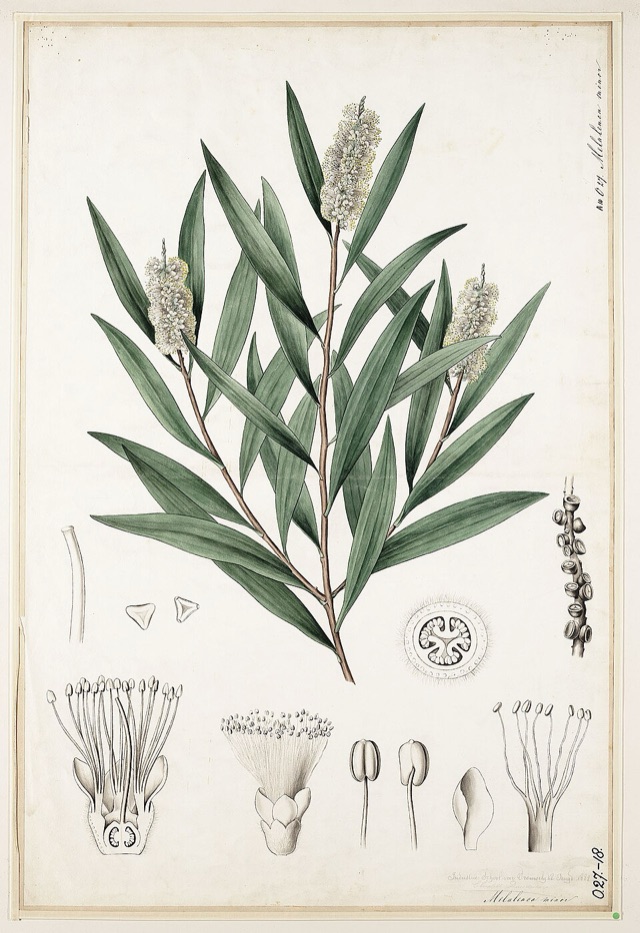
Minyak kayu putih is the Malay world's household vapour oil, but nearly all clinical evidence for inhaled or ingested 1,8-cineole comes from purified eucalyptus-derived cineole taken orally, not from cajuput oil itself, whose own literature is compositional and laboratory-based.
- Parts used
- Leaf, Essential oil
- Native range
- Native. Indo-China to N. Northern Territory (POWO/WCVP).
- Habitat
- Forest
- Scent profile
- Camphoraceous, Herbal
- Evidence grade
- C: Pre-clinical work or documented traditional use only
Traditional and heritage uses
Minyak kayu putih is arguably the most domesticated bottle in the Malay
world's cupboard: an oil distilled from the leaves and twigs of the gelam
tree (the "white wood" that gives the oil its name) kept in the family
cupboard and rubbed on chests, temples and the backs of necks as everyday
household practice. The tree's traditional uses across the region are
assembled in the modern scoping literature [1].
Behind the bottle is a landscape and an industry. The species is endemic
to the Moluccas, where Buru, Seram and Ambon carry the classic cajuput
resource, and where documented national production has long run far below
domestic demand [2]; an Indonesian breeding programme has since worked to
lift oil yield from the traditional base [3]. In the Malay peninsula the
same tree is a peat-swamp and coastal species, gelam, mapped across the
East Coast, Terengganu especially, where it matters to both the local
economy and coastal protection [4], and studied for the conservation and
rehabilitation of the degraded peat swamp forest it belongs to [5].
The oil entered global commerce centuries ago as "cajuput", a direct
borrowing of kayu putih, and the trade name still marks every historical
account of the Malay archipelago's distilled oils [2].
Scent profile
- Camphoraceous Fresh cineole vapour from the distilled leaf oil.
- Herbal Green leaf and twig.
What the evidence says
The honest starting point of most botanical literature, and of most of our library.
What the grades mean- VIISystematic reviewGrade A
- VIClinical studiesGrade A–B
- VHuman observationalGrade B–C
- IVPreclinicalGrade C
- IIILaboratoryGrade C
- IIPhytochemicalGrade C
- ITraditional useGrade C
The ladder explains the grade; it never replaces it. Evidence for this plant reaches clinical studies, which is why the entry is graded C.
Cautions and safety
The hazard literature is unambiguous where it matters most: small ingested
volumes of cineole-rich oils have caused central nervous system depression
and seizures in infants and young children, documented by Tibballs (1995)
for eucalyptus oil [8] with modern case reports continuing to accrue [9].
The same hazard transfers directly to minyak kayu putih in homes with
small children: keep the bottle out of reach, never administer orally,
and do not apply near the face of an infant. On adult skin the diluted
oil is generally well tolerated; the neat oil can irritate.
A regulatory-grade assessment now exists: the European Food Safety
Authority's 2024 opinion on cajuput oil sets out a compositional
specification and exposure assessment for the oil as such [12]. It
concerns animal feed use rather than human vapour, but it is the most
authoritative compositional and safety document available for this
specific oil, and it reinforces the point above about specifying batch
cineole content rather than assuming it.
This entry records documented traditional use. This is not medical advice; speak to a qualified practitioner.
Sources (18)
- Isah M, Rosdi RA, Abdullah H, Sul'ain MD, Ishak WRW (2023). Phytoconstituents and biological activities of Melaleuca cajuputi Powell: a scoping review. Journal of Applied Pharmaceutical Science 13(1): 10–23. Source
- Pujiarti R, Ohtani Y, Ichiura H (2011). Physicochemical properties and chemical compositions of Melaleuca leucadendron leaf oils taken from the plantations in Java, Indonesia. Journal of Wood Science 57: 446–451. Source
- Septiana S, Yuliana ND, Bachtiar BM, Putri SP, Fukusaki E, Laviña WA, Wijaya CH (2020). Metabolomics approach for determining potential metabolites correlated with sensory attributes of Melaleuca cajuputi essential oil, a promising flavor ingredient. Journal of Bioscience and Bioengineering 129(5): 581–587. Source
- Pino J, Bello A, Urquiola A, Aguero J, Marbot R (2002). Chemical composition of cajuput oil (Melaleuca leucadendra L.) from Cuba. Journal of Essential Oil Research 14(1): 10–11. Source
- Kehrl W, Sonnemann U, Dethlefsen U (2004). Therapy for acute nonpurulent rhinosinusitis with cineole: results of a double-blind, randomized, placebo-controlled trial. Laryngoscope 114(4): 738–742. Source
- Worth H, Schacher C, Dethlefsen U (2009). Concomitant therapy with cineole (eucalyptole) reduces exacerbations in COPD: a placebo-controlled double-blind trial. Respiratory Research 10: 69. Source
- Al-Abd NM, et al. (2015). Antioxidant, antibacterial activity, and phytochemical characterization of Melaleuca cajuputi extract. BMC Complementary and Alternative Medicine 15: 385. Source
- Tibballs J (1995). Clinical effects and management of eucalyptus oil ingestion in infants and young children. Medical Journal of Australia 163(4): 177–180. Source
- Ittyachen AM, George GR, Radhakrishnan M, Joy Y (2019). Eucalyptus oil poisoning: two case reports. Journal of Medical Case Reports 13: 326. Source
- Rimbawanto A, Kartikawati NK, Latumahina F (2021). Conservation and utilization of Melaleuca cajuputi sub sp cajuputi, an indigenous species in Moluccas Island, Indonesia. IOP Conference Series: Earth and Environmental Science 800(1): 012040. Source
- Kartikawati NK, Nirsatmanto A, Rimbawanto A, et al. (2023). Genetic gain in oil productivity from breeding program of cajuput (Melaleuca cajuputi subsp. cajuputi) in Indonesia. Forest Science and Technology 19(4): 309–314. Source
- Ab Lah NZ, Yusop Z, Hashim M, Mohd Salim J, Numata S (2021). Predicting the habitat suitability of Melaleuca cajuputi based on the MaxEnt species distribution model. Forests 12(11): 1449. Source
- Hadiyan Y, Widiyatno, Nurtjahjaningsih I, Na''iem M, Herdyantara B, Isno (2022). Genetic diversity and structure among four provenances of gelam (Melaleuca cajuputi subsp. cumingiana) and implications for gene conservation and rehabilitation of degraded peat swamp forest in Indonesia. Forest Science and Technology 18(4): 135–143. Source
- Arif Azimi Md Noor (2023). Melaleuca cajuputi Powell essential oil: a review of botanical, phytochemical and pharmacological properties. Borneo Journal of Resource Science and Technology 13(2): 1–12. Source
- Desdiani D, Fadilah F, Sutarto AP (2022). The effects of Melaleuca cajuput oil (Melaleuca cajuputi) herbal treatment on clinical, laboratory, and radiological improvement and length of hospital stay in COVID-19 patients. Journal of Applied Pharmaceutical Science 12(6): 122–127. Source
- EFSA FEEDAP Panel (2024). Safety and efficacy of a feed additive consisting of an essential oil derived from fresh leaves of Melaleuca cajuputi Maton & Sm. ex R. Powell and Melaleuca leucadendra (L.) L. (cajuput oil) for use in all animal species. EFSA Journal 22(4): e8732. Source
- Isah M, Sul''ain MD, Wan Abdul Wahab WNA, et al. (2025). Chemical profiling and mechanistic insights into the antibacterial efficacy of Melaleuca cajuputi leaf extract. BMC Complementary Medicine and Therapies 25(1): 121. Source
- Kapelle IBD, Souhoka FA, Rosmawaty, Jani AUB, Jelita WP, Silahooy VB (2025). Chemical composition of essential oils reviewed from the height of cajuput (Melaleuca leucadendron) plantations in Buru Island and Seram Island, Maluku, Indonesia. Open Chemistry 23(1): 20250172. Source