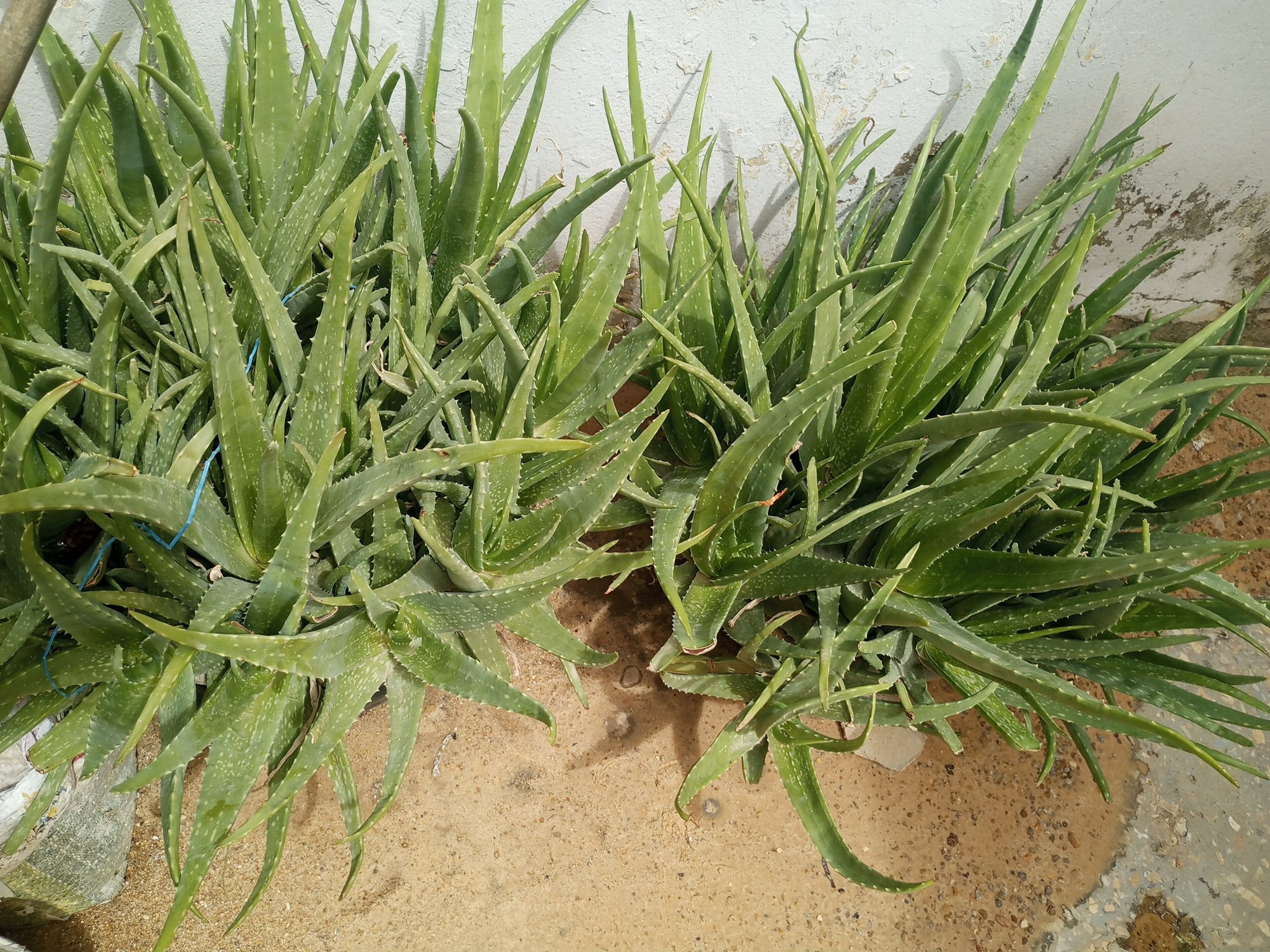
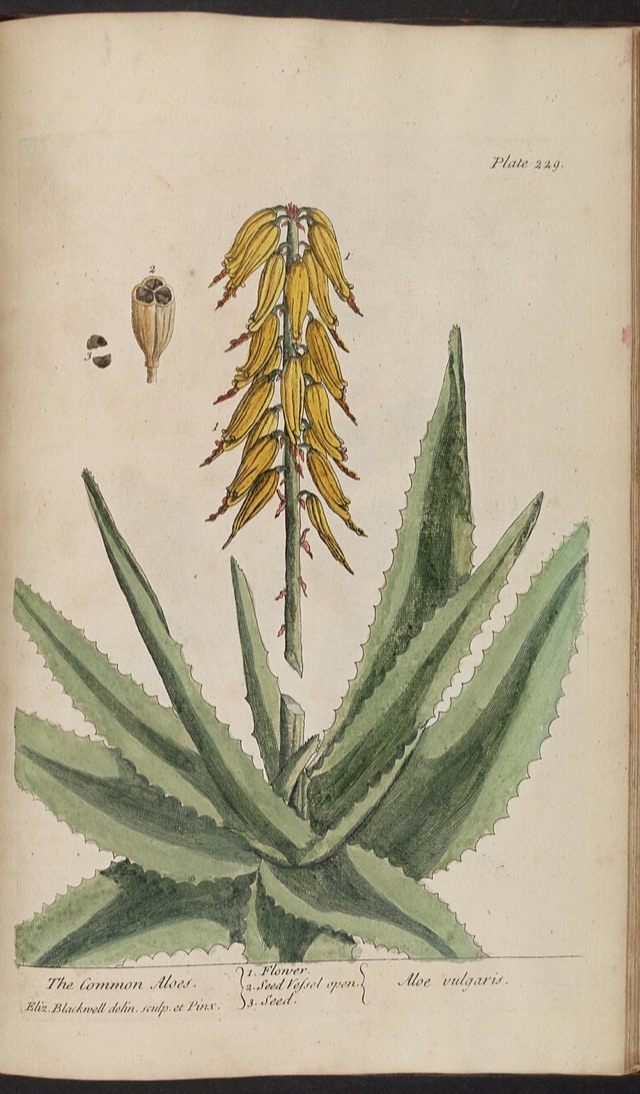
Lidah buaya
Aloe vera
ENAloe vera, Aloe
- MSLidah buaya
- IDLidah buaya
- ENAloe vera
Synonym: Aloe barbadensis Mill.
Family: Asphodelaceae
Topical aloe gel carries limited clinical evidence for the care of minor, superficial burns: a 2007 systematic review of four controlled trials and a handful of small comparative studies report shorter times to wound closure [5], but the preparations vary widely and no adequately blinded trial of a standardised gel exists.
- Parts used
- Leaf
- Native range
- Introduced or naturalised. N. Oman (Hajar Mts.) (POWO/WCVP).
- Habitat
- Garden
- Evidence grade
- B: Limited clinical evidence
Traditional and heritage uses
The lidah buaya ("crocodile's tongue") grows by the kitchen door across
the Malay world, kept close because it is reached for often. The household
practice is simple and old: a leaf is split and the cool inner gel laid
against scalded or sun-caught skin [1, 2].
In the Malaysian field record it appears as one of the plants households
actually keep rather than one they merely know. A survey of a
Javanese-Malay community in Parit Jelutong, Batu Pahat, drawing on 113
respondents and 112 species, records lidah buaya among the four most
frequently cited [1]; homegarden surveys across the Straits find the same
plant kept within reach for everyday care [2]. A scoping review of
Indonesian ethnopharmacology for wound care, covering 238 species, places
it among the eleven most commonly used [3]. It also reaches the manuscript
corpus, if only in passing: the review literature on Malay medical
manuscripts records it among the ingredients tabulated for eye
preparations [4].
The plant keeps two materials in one leaf, and the tradition has always
separated them: the clear inner gel for the skin, and the bitter yellow
latex beneath the rind, which belongs to a different, purgative use and is
not part of the household skin practice [5].
What the evidence says
Human trials exist but are few, small, or not yet replicated.
What the grades mean- VIISystematic reviewGrade A
- VIClinical studiesGrade A–B
- VHuman observationalGrade B–C
- IVPreclinicalGrade C
- IIILaboratoryGrade C
- IIPhytochemicalGrade C
- ITraditional useGrade C
The ladder explains the grade; it never replaces it. Evidence for this plant reaches systematic review, which is why the entry is graded B.
Cautions and safety
Topical aloe gel is generally well tolerated on intact and superficially
injured skin. Allergic contact dermatitis is documented (patch-test
confirmed cases exist, including to home-made leaf preparations [8]), so a
patch test before first use is sensible, and use should stop if stinging or
rash develops. The Guo and Mei 2016 toxicology review distinguishes the
topical gel, with its low adverse-effect profile, from oral whole-leaf
extract, whose anthraquinone content carries laxative effects and separate
regulatory concern [9]. Deep, extensive or infected burns need clinical
care, not a plant preparation; this monograph concerns minor superficial
burns only. Data in pregnancy for topical use are limited.
A 2025 comprehensive review restates the distinction that matters most
here: topical gel is well tolerated, while prolonged intake of
anthraquinone-rich latex carries hepatotoxic and nephrotoxic risk [12].
That is a caution about the wrong part of the leaf taken the wrong way,
and it is precisely the separation the tradition already makes.
This entry records documented traditional use. This is not medical advice; speak to a qualified practitioner.
Sources (15)
- Grindlay D, Reynolds T (1986). The Aloe vera phenomenon: a review of the properties and modern uses of the leaf parenchyma gel. Journal of Ethnopharmacology 16(2–3): 117–151. Source
- Ong HC, Nordiana M (1999). Malay ethno-medico botany in Machang, Kelantan, Malaysia. Fitoterapia 70(5): 502–513. Source
- Hamman JH (2008). Composition and applications of Aloe vera leaf gel. Molecules 13(8): 1599–1616. Source
- Liu C, Cui Y, Pi F, Cheng Y, Guo Y, Qian H (2019). Extraction, purification, structural characteristics, biological activities and pharmacological applications of acemannan, a polysaccharide from Aloe vera: a review. Molecules 24(8): 1554. Source
- Maenthaisong R, Chaiyakunapruk N, Niruntraporn S, Kongkaew C (2007). The efficacy of aloe vera used for burn wound healing: a systematic review. Burns 33(6): 713–718. Source
- Visuthikosol V, Chowchuen B, Sukwanarat Y, Sriurairatana S, Boonpucknavig V (1995). Effect of aloe vera gel to healing of burn wound: a clinical and histologic study. Journal of the Medical Association of Thailand 78(8): 403–409. Source
- Khorasani G, Hosseinimehr SJ, Azadbakht M, Zamani A, Mahdavi MR (2009). Aloe versus silver sulfadiazine creams for second-degree burns: a randomized controlled study. Surgery Today 39(7): 587–591. Source
- Ferreira M, Teixeira M, Silva E, Selores M (2007). Allergic contact dermatitis to Aloe vera. Contact Dermatitis 57(4): 278–279. Source
- Guo X, Mei N (2016). Aloe vera: a review of toxicity and adverse clinical effects. Journal of Environmental Science and Health, Part C 34(2): 77–96. Source
- Ismail NA, Sabran SF, Mohamed M, Abu Bakar MF (2018). Ethnomedicinal knowledge of plants used for healthcare by the Javanese-Malay community in Parit Jelutong, Batu Pahat, Johor, Malaysia. AIP Conference Proceedings 2002: 020048. Source
- Swastini DA, Martien R, Fachiroh J, Nugroho AE (2025). Ethnopharmacology and bioactive evidence of medicinal plants for wound healing in Indonesia: a scoping review. Journal of Applied Pharmaceutical Science 15(6): 10–30. Source
- Idrus ANA, Rehman K, Zulfakar MH (2023). A systematic review of the clinical effectiveness of Aloe vera for the prevention and treatment of chronic wounds. Sains Malaysiana 52(6): 1785–1794. Source
- Lee ZM, Goh BH, Khaw KY (2025). Aloe vera and the proliferative phase of cutaneous wound healing: status quo report on active principles, mechanisms, and applications. Planta Medica 91(1–02): 4–18. Source
- Abid A, Javed M, Zafar S, et al. (2025). The green healer: an updated review on the phytochemical profile and therapeutic potential of Aloe vera. Frontiers in Nutrition 12: 1689700. Source
- Zou H, Liu Z, Wang Z, Fang J (2022). Effects of Aloe vera in the treatment of oral ulcers: a systematic review and meta-analysis of randomised controlled trials. Oral Health & Preventive Dentistry 20: 509–516. Source