Pegaga
Centella asiatica
ENAsiatic pennywort, Gotu kola
- MSPegaga
- IDPegagan
- IDAntanan
- ENGotu kola
Synonym: Hydrocotyle asiatica L.
Family: Apiaceae
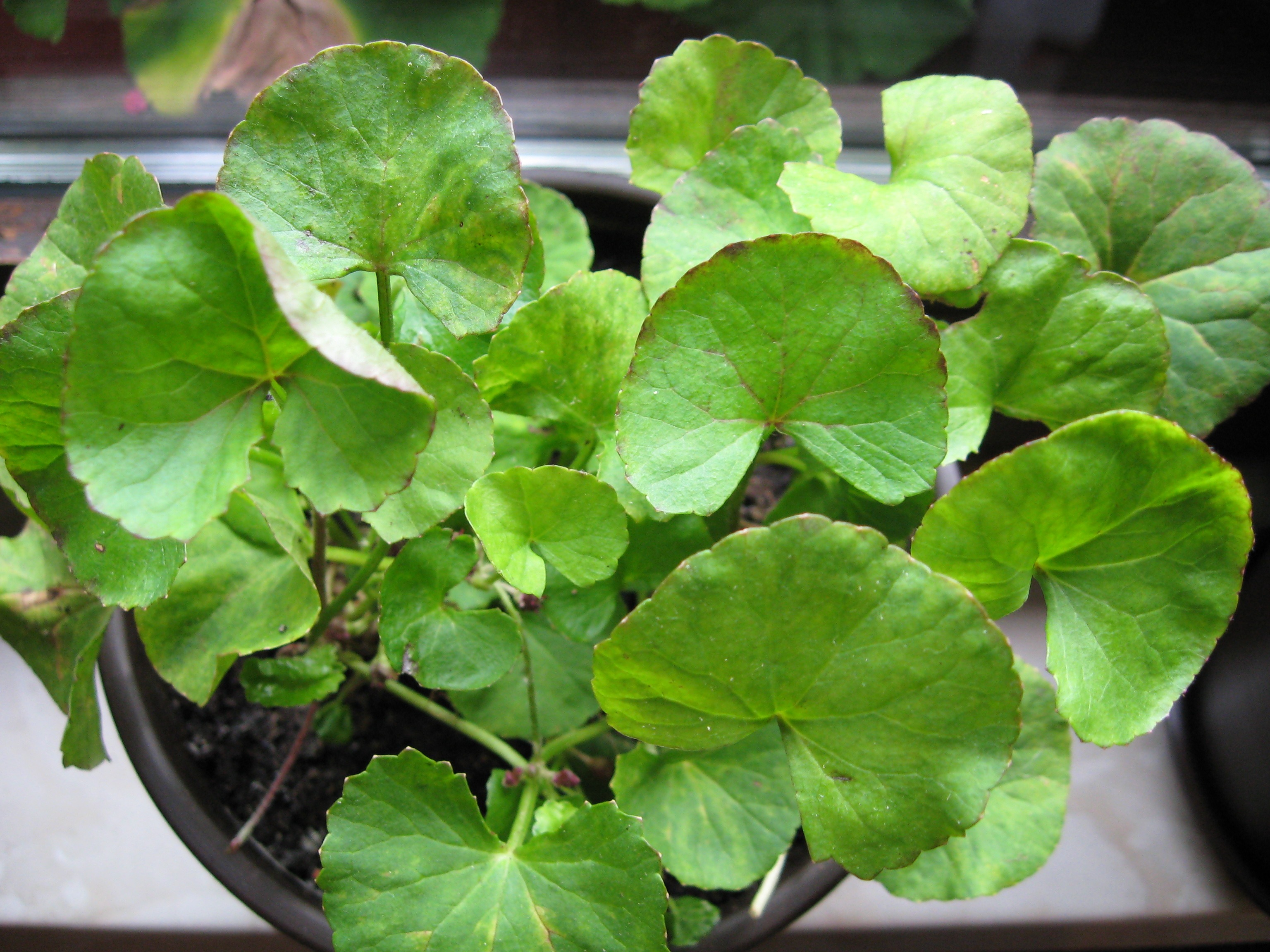
Pegaga's reputation in skin recovery rests on laboratory and animal work on its triterpenes, especially asiaticoside; the human studies that exist are small, mostly unblinded, and largely concern oral extract in clinical wound settings rather than the traditional topical use.
- Parts used
- Leaf, Whole plant
- Native range
- Native. Caucasus, Trop. & Subtrop. Old World to E. Australia and W. Pacific (POWO/WCVP).
- Habitat
- Garden
- Evidence grade
- C: Pre-clinical work or documented traditional use only
Traditional and heritage uses
Pegaga is eaten before anything else is done with it. The fresh leaf is a
fixture of the Malay ulam table (picked, washed and eaten raw with rice),
and its place in the region's food culture is documented as thoroughly as
any use of the plant [1].
It is one of the few Nusantara botanicals with a study devoted to its
standing in Malay life specifically: a systematic review from Universiti
Sains Islam Malaysia gathers more than forty works on pegaga within the
Malay community, mapping the record across Sabah, Perak, Selangor and
Terengganu and through the writings of Malay scholars [2]. It also sits in
the manuscript tradition: the medical chapter of Tajul Muluk, a Malay
text compiled by the Achehnese scholar Shaykh Isma'il al-'Asyi, carries
pegaga in its plant inventory of 209 materials [3].
Where researchers have tried to measure how strongly a plant belongs to a
community's food, pegaga scores at the top: in a Sama-Bajau ulam survey in
Kota Belud, Sabah, it shares the highest use value of twenty-eight species
recorded [4]. Malay home gardens in Perak keep it by name [5], and across
the Strait it reaches the traditional markets of the Jakarta metropolitan
area as pegagan, sold to be eaten fresh as lalapan [6]. Across Southeast
and South Asia the same small creeping herb is recorded as both a daily
leafy vegetable and a traditional medicine [7].
What the evidence says
The honest starting point of most botanical literature, and of most of our library.
What the grades mean- VIISystematic reviewGrade A
- VIClinical studiesGrade A–B
- VHuman observationalGrade B–C
- IVPreclinicalGrade C
- IIILaboratoryGrade C
- IIPhytochemicalGrade C
- ITraditional useGrade C
The ladder explains the grade; it never replaces it. Evidence for this plant reaches clinical studies, which is why the entry is graded C.
Cautions and safety
Eaten as a vegetable, pegaga has a long record of apparently safe use.
Applied to skin, contact dermatitis to centella-derived topicals is
documented: the classic report concerns Madecassol, a concentrated
pharmaceutical extract, with positive component patch tests [9]. A patch
test before first topical use is sensible. Broken or infected skin needs
clinical care rather than a plant preparation, and data in pregnancy for
concentrated extracts are limited.
This entry records documented traditional use. This is not medical advice; speak to a qualified practitioner.
Sources (17)
- Hashim P (2011). Centella asiatica in food and beverage applications and its potential antioxidant and neuroprotective effect. International Food Research Journal 18(4): 1215–1222. Source
- Chandrika UG, Prasad Kumara PAAS (2015). Gotu kola (Centella asiatica): nutritional properties and plausible health benefits. Advances in Food and Nutrition Research 76: 125–157. Source
- James JT, Dubery IA (2009). Pentacyclic triterpenoids from the medicinal herb, Centella asiatica (L.) Urban. Molecules 14(10): 3922–3941. Source
- Shukla A, Rasik AM, Jain GK, Shankar R, Kulshrestha DK, Dhawan BN (1999). In vitro and in vivo wound healing activity of asiaticoside isolated from Centella asiatica. Journal of Ethnopharmacology 65(1): 1–11. Source
- Somboonwong J, Kankaisre M, Tantisira B, Tantisira MH (2012). Wound healing activities of different extracts of Centella asiatica in incision and burn wound models: an experimental animal study. BMC Complementary and Alternative Medicine 12: 103. Source
- Paocharoen V (2010). The efficacy and side effects of oral Centella asiatica extract for wound healing promotion in diabetic wound patients. Journal of the Medical Association of Thailand 93(Suppl 7): S166–S170. Source
- Bylka W, Znajdek-Awiżeń P, Studzińska-Sroka E, Brzezińska M (2013). Centella asiatica in cosmetology. Postępy Dermatologii i Alergologii 30(1): 46–49. Source
- Bylka W, Znajdek-Awiżeń P, Studzińska-Sroka E, Dańczak-Pazdrowska A, Brzezińska M (2014). Centella asiatica in dermatology: an overview. Phytotherapy Research 28(8): 1117–1124. Source
- Eun HC, Lee AY (1985). Contact dermatitis due to Madecassol. Contact Dermatitis 13(5): 310–313. Source
- Tg Abdul Rahman TAF, Abd Aziz NA, Yusof NNM, Hadizam BB, Islieh ARIS (2020). Systematic literature review on Centella asiatica. Sains Insani 5(1): 135–141. Source
- Mohd Shafri MA, Nazarudin AN (2022). Tajul Muluk: a traditional Malay text of ethnobotany and ethnomedicine. Borneo Journal of Resource Science and Technology 12(2): 74–81. Source
- Awang-Kanak F, Abu Bakar MF, Mohamed M (2018). Ethnobotanical survey on plants used as traditional salad food (ulam) in Kampung Taun Gusi, Kota Belud Sabah, Malaysia. AIP Conference Proceedings 2002: 020024. Source
- Marpaung AA, Fitmawati F, Nobis M (2025). Wild plants in traditional markets of the Jakarta Metropolitan Area and their use in Indonesian culture: an ethnobotanical survey. Acta Societatis Botanicorum Poloniae 94: 1–19. Source
- Sun B, Wu L, Wu Y, et al. (2020). Therapeutic potential of Centella asiatica and its triterpenes: a review. Frontiers in Pharmacology 11: 568032. Source
- Hein ZM, Gopalakrishna PK, Kanuri AK, et al. (2025). Centella asiatica: advances in extraction technologies, phytochemistry, and therapeutic applications. Life 15(7): 1081. Source
- Wright KM, Bollen M, David J, et al. (2022). Pharmacokinetics and pharmacodynamics of key components of a standardized Centella asiatica product in cognitively impaired older adults: a phase 1, double-blind, randomized clinical trial. Antioxidants 11(2): 215. Source
- Mando Z, Mando H, Afzan A, Shaari K, Hassan Z, Mohamad Taib MNA, Zakaria F (2024). Biomarker triterpenoids of Centella asiatica as potential antidepressant agents: combining in vivo and in silico studies. Behavioural Brain Research 466: 114976. Source