Jambu batu
Psidium guajava
ENGuava
- MSJambu batu
- MSJambu biji
- JVJambu klutuk
- ENGuava
Synonym: Psidium pyriferum L.
Family: Myrtaceae
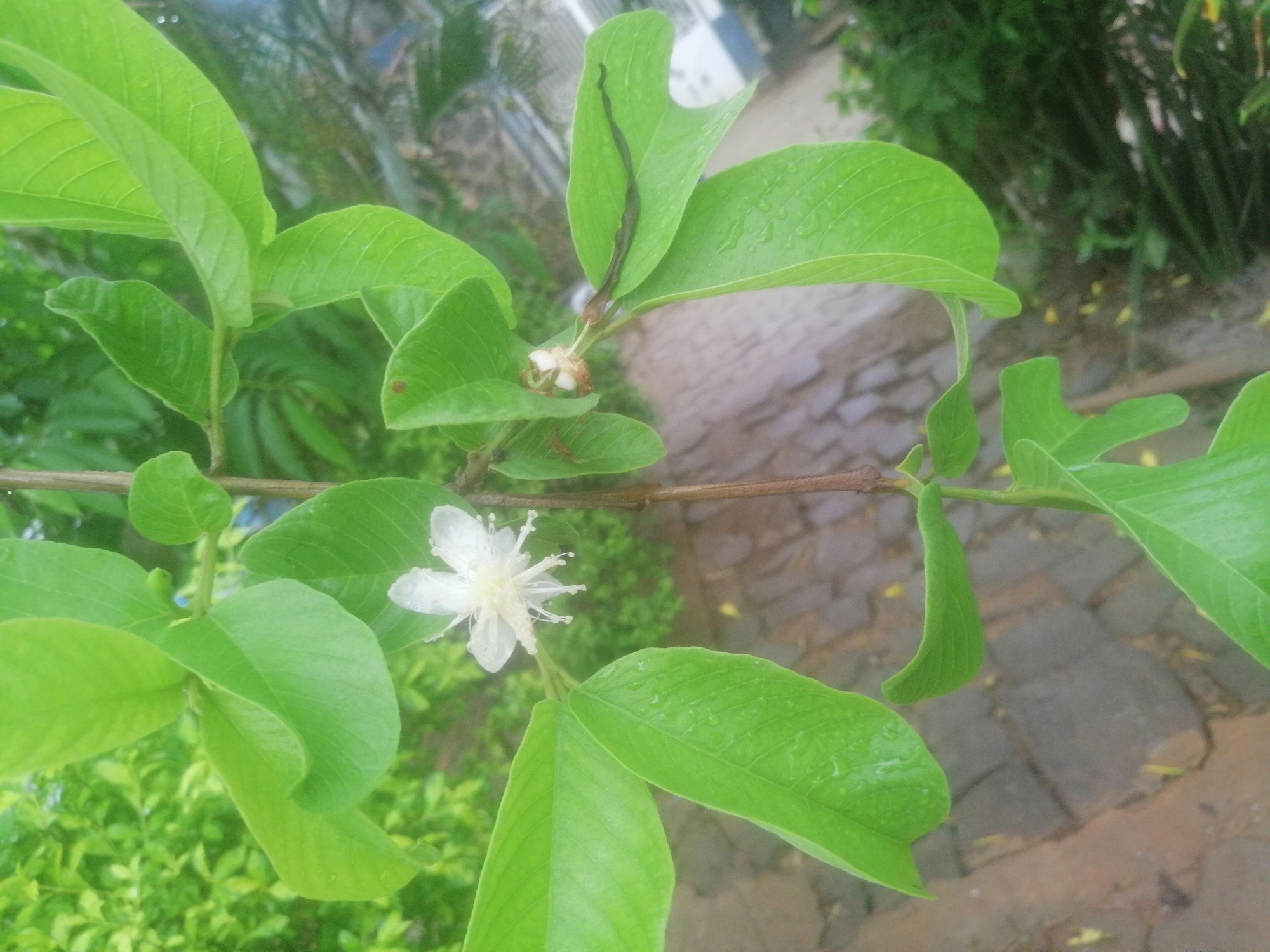
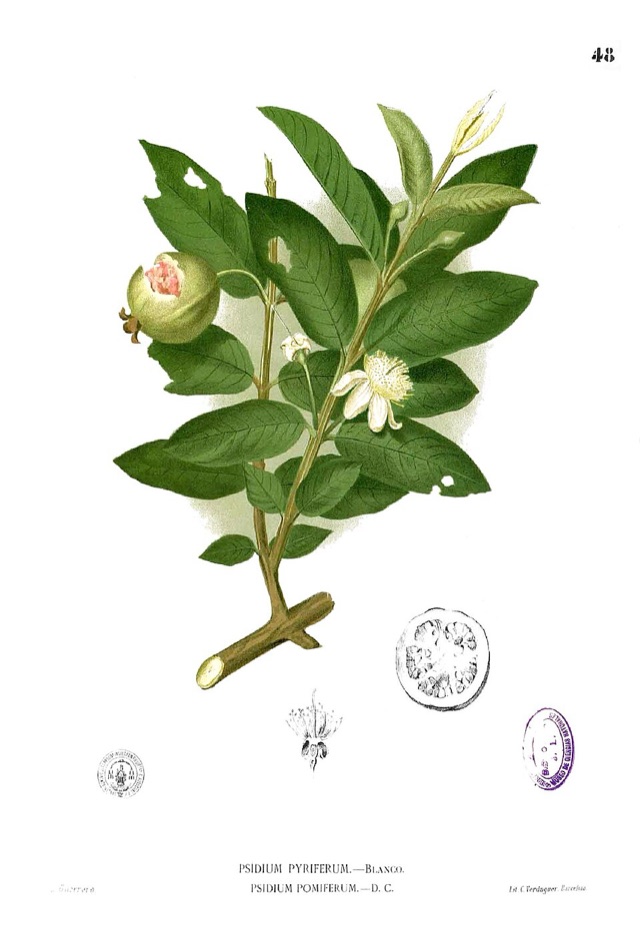
Guava-leaf washes are a documented Malay external remedy, and the modern literature offers a mouse model of eczema-like skin plus human-keratinocyte mechanism work, but no clinical trial of a topical guava-leaf preparation on irritated human skin has been published.
- Parts used
- Leaf, Fruit
- Native range
- Introduced or naturalised. as a cultigen from Peru (POWO/WCVP).
- Habitat
- Garden
- Evidence grade
- C: Pre-clinical work or documented traditional use only
Traditional and heritage uses
The guava tree is grown for its fruit and consulted for its leaves. In the
Malaysian record the leaf is one of the most consistently documented
household remedies there is, and the naming shifts as you travel: jambu
batu, jambu biji, and in the Sambas Malay of West Kalimantan, jambu bigek
[1].
The Kelantan survey at Machang records the leaves used externally as a
wash on wounds [2]. A Terengganu village study is more specific still:
young leaves rubbed on the body for odour and rough skin, and mashed
leaves taken by mothers after childbirth [3], a topical and postpartum
use that the standard international literature largely omits. In Pahang,
practitioners brew the leaves for the gut or grind them into a poultice
for open wounds and rashes [4].
The record runs across communities as well as states. Temuan villagers in
Selangor and Negeri Sembilan keep guava leaf among their few
gastrointestinal remedies [5, 6], the Jah Hut of Pahang likewise [7], and
Malay home gardens in Perak record it as leaf infusion [8]. The Sambas
study is unusual in preserving a dose: three to seven leaves, washed,
once daily [1]. The daun jambu also sits inside the ulam canon, the
thirty-two traditional Malaysian vegetables, which is where food and
remedy stop being separable [9].
What the evidence says
The honest starting point of most botanical literature, and of most of our library.
What the grades mean- VIISystematic reviewGrade A
- VIClinical studiesGrade A–B
- VHuman observationalGrade B–C
- IVPreclinicalGrade C
- IIILaboratoryGrade C
- IIPhytochemicalGrade C
- ITraditional useGrade C
The ladder explains the grade; it never replaces it. Evidence for this plant reaches clinical studies, which is why the entry is graded C.
Cautions and safety
Dedicated topical safety studies are lacking; what safety coverage exists
sits in the toxicology sections of the major reviews [2, 3], which report
wide margins in animal studies of leaf extracts. Tannin-rich decoctions
are astringent and can dry or temporarily stain skin with repeated use.
No patch-test data exist for leaf preparations on compromised skin, so
the practical advice is the usual: patch-test first, stop on irritation,
and keep diagnosed skin conditions under clinical care.
This entry records documented traditional use. This is not medical advice; speak to a qualified practitioner.
Sources (19)
- Ong HC, Nordiana M (1999). Malay ethno-medico botany in Machang, Kelantan, Malaysia. Fitoterapia 70(5): 502–513. Source
- Gutiérrez RMP, Mitchell S, Solis RV (2008). Psidium guajava: a review of its traditional uses, phytochemistry and pharmacology. Journal of Ethnopharmacology 117(1): 1–27. Source
- Díaz-de-Cerio E, Verardo V, Gómez-Caravaca AM, Fernández-Gutiérrez A, Segura-Carretero A (2017). Health effects of Psidium guajava L. leaves: an overview of the last decade. International Journal of Molecular Sciences 18(4): 897. Source
- Choi JH, Park BH, Kim HG, Hwang YP, Han EH, Jin SW, Seo JK, Chung YC, Jeong HG (2012). Inhibitory effect of Psidium guajava water extract in the development of 2,4-dinitrochlorobenzene-induced atopic dermatitis in NC/Nga mice. Food and Chemical Toxicology 50(8): 2923–2929. Source
- Han EH, Hwang YP, Choi JH, Yang JH, Seo JK, Chung YC, Jeong HG (2011). Psidium guajava extract inhibits thymus and activation-regulated chemokine (TARC/CCL17) production in human keratinocytes by inducing heme oxygenase-1 and blocking NF-κB and STAT1 activation. Environmental Toxicology and Pharmacology 32(2): 136–145. Source
- Ojewole JAO (2006). Antiinflammatory and analgesic effects of Psidium guajava Linn. (Myrtaceae) leaf aqueous extract in rats and mice. Methods and Findings in Experimental and Clinical Pharmacology 28(7): 441–446. Source
- Qa'dan F, Thewaini AJ, Ali DA, Afifi R, Elkhawad A, Matalka KZ (2005). The antimicrobial activities of Psidium guajava and Juglans regia leaf extracts to acne-developing organisms. American Journal of Chinese Medicine 33(2): 197–204. Source
- Ong HC, Ruzalila BN, Milow P (2011). Traditional knowledge of medicinal plants among the Malay villagers in Kampung Tanjung Sabtu, Terengganu, Malaysia. Indian Journal of Traditional Knowledge 10(3): 460–465. Source
- Panjaitan RGP, Kurniasi A, Wahyuni ES, et al. (2025). Medicinal plants for digestive system disorders in Tebing Batu Village, Sambas District, West Kalimantan, Indonesia. Biodiversitas 26(11): 5647–5658. Source
- Ramli MR, Malek S, Milow P, Aziz NJ (2021). Traditional knowledge of medicinal plants in the Kampung Orang Asli Donglai Baru, Hulu Langat, Malaysia. Biodiversitas 22(3): 1304–1309. Source
- Bachok MF, Mohd Yusof BN, Ismail A, Abdul Hamid A (2014). Effectiveness of traditional Malaysian vegetables (ulam) in modulating blood glucose levels. Asia Pacific Journal of Clinical Nutrition 23(3): 369–376. Source
- Liu C, Jullian V, Chassagne F (2024). Ethnobotany, phytochemistry, and biological activities of Psidium guajava in the treatment of diarrhea: a review. Frontiers in Pharmacology 15: 1459066. Source
- Kumar M, Tomar M, Amarowicz R, et al. (2021). Guava (Psidium guajava L.) leaves: nutritional composition, phytochemical profile, and health-promoting bioactivities. Foods 10(4): 752. Source
- Huynh HD, Nargotra P, Wang HD, Shieh CJ, Liu YC, Kuo CH (2025). Bioactive compounds from guava leaves (Psidium guajava L.): characterization, biological activity, synergistic effects, and technological applications. Molecules 30(6): 1278. Source
- Kakuo S, Fushimi T, Kawasaki K, Nakamura J, Ota N (2018). Effects of Psidium guajava Linn. leaf extract in Japanese subjects with knee pain: a randomized, double-blind, placebo-controlled, parallel pilot study. Aging Clinical and Experimental Research 30(11): 1391–1398. Source
- Nayak N, Varghese J, Shetty S, et al. (2019). Evaluation of a mouthrinse containing guava leaf extract as part of comprehensive oral care regimen: a randomized placebo-controlled clinical trial. BMC Complementary and Alternative Medicine 19(1): 327. Source
- Wongsanao T, Leemingsawat W, Panapisal V, Kritpet T (2021). Thermoregulatory effects of guava leaf extract-menthol toner application for post-exercise use. Pharmaceutical Biology 59(1): 852–857. Source
- Lozoya X, Reyes-Morales H, Chávez-Soto MA, et al. (2002). Intestinal anti-spasmodic effect of a phytodrug of Psidium guajava folia in the treatment of acute diarrheic disease. Journal of Ethnopharmacology 83(1–2): 19–24. Source
- Ishak SA, Ariffin N, Azmi FF (2024). Kesan ekstrak daun jambu batu (Psidium guajava) terhadap eritrosit terinfeksi Plasmodium berghei NK65. Sains Malaysiana 53(4): 869–880. Source