Mengkudu
Morinda citrifolia
ENNoni, Indian mulberry
- MSMengkudu
- JVPace
- IDMengkudu
- ENNoni
Family: Rubiaceae
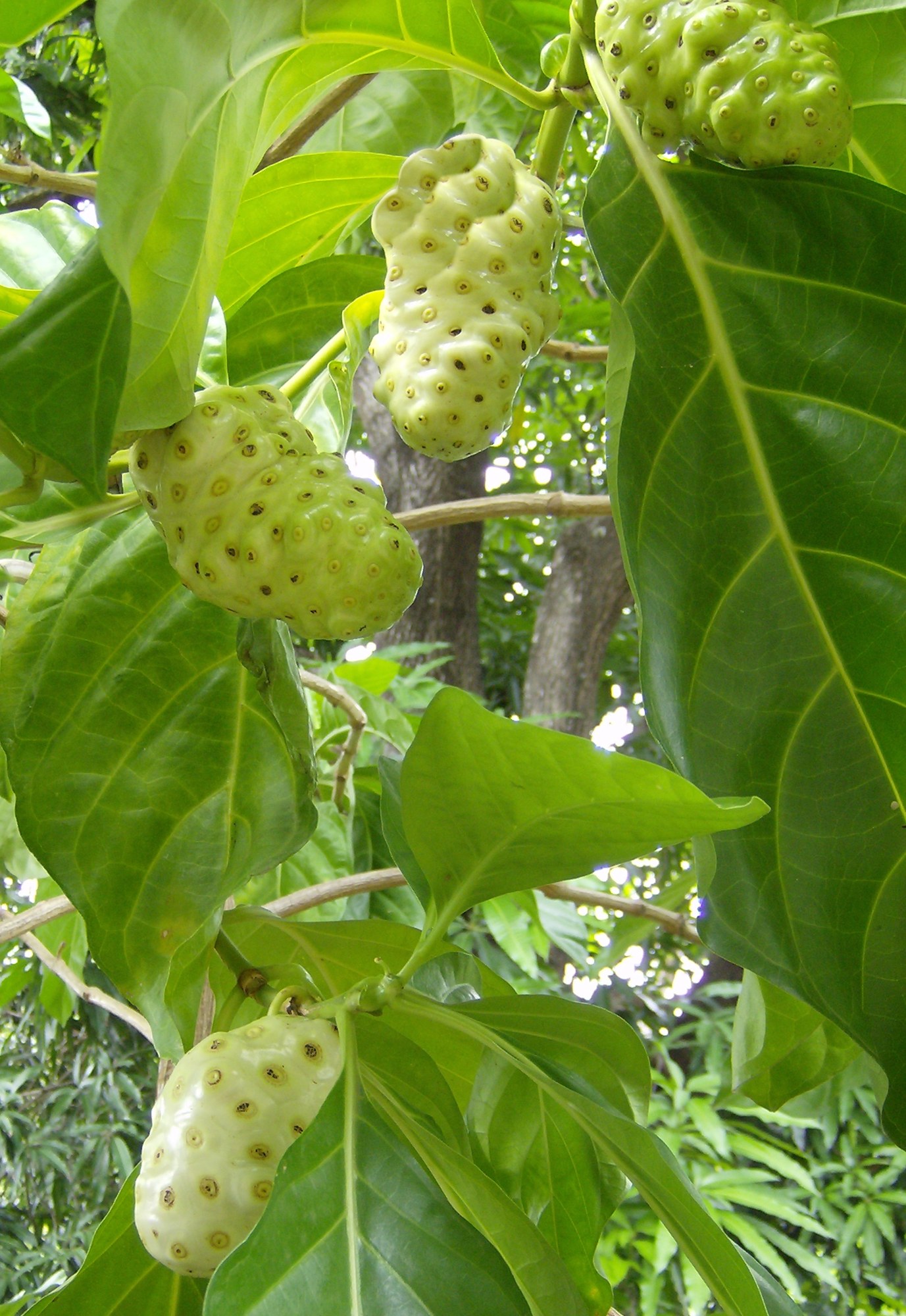
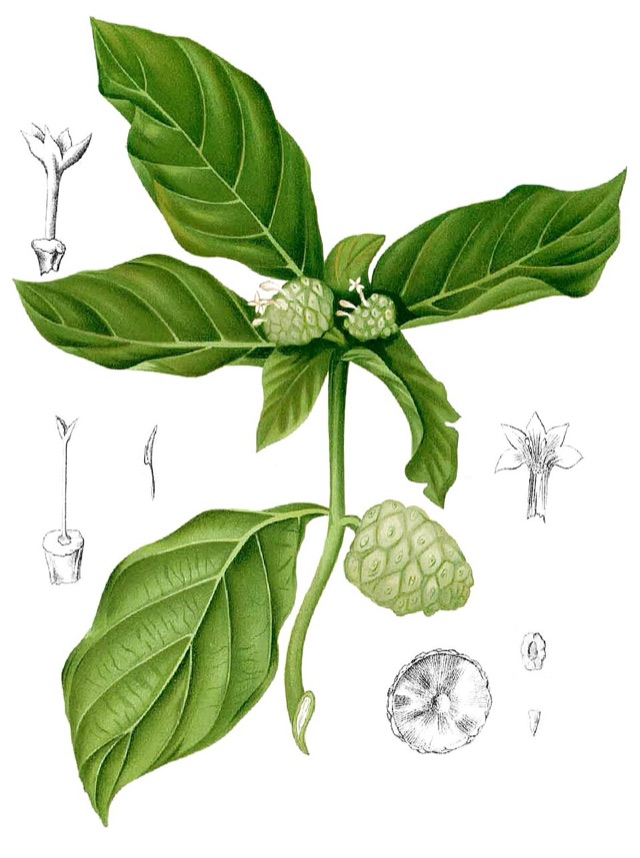
The heated mengkudu leaf is a documented topical remedy across the Malay world and the Pacific; the modern literature offers rodent wound-model work and solid leaf-specific safety data, but no human study of the poultice practice itself.
- Parts used
- Leaf, Fruit
- Native range
- Native. Trop. & Subtrop. Asia to N. Australia (POWO/WCVP).
- Habitat
- Garden
- Evidence grade
- C: Pre-clinical work or documented traditional use only
Traditional and heritage uses
Long before noni juice reached the health-food shelf, the mengkudu tree's
leaves were the working part of the plant. The historical record is
explicit on this: traditional Pacific and archipelago practice centred on
the leaves, roots and bark used topically, the heated leaf pressed to the
skin, while the fruit-juice framing is a modern commercial development
[1].
In Malaysia the leaf's place is documented at national scale. The Forest
Research Institute Malaysia's decade-long survey of Malay traditional
practitioners, 358 practitioners across four phases, records thirty-seven
species used in bertungku, the postpartum hot-compress practice, with
mengkudu among the five most commonly used [2]. A Universiti Kebangsaan
Malaysia survey of thirty-six female practitioners in Perak found leaves
the dominant plant part across 139 postpartum species, and mengkudu the
second most frequently named plant of all [3]; the compilation of Malay
postnatal preparations sits behind both [4]. Kelantanese midwifery
practice places it in bertangas, bertungku and mandi serom [5].
The name travels with the plant: bingkudu among Orang Asli communities in
Perak [6], pace in Javanese, and a wide family of Pacific names (nonu,
nono, nen), where the tree is equally at home in the village garden [7].
What the evidence says
The honest starting point of most botanical literature, and of most of our library.
What the grades mean- VIISystematic reviewGrade A
- VIClinical studiesGrade A–B
- VHuman observationalGrade B–C
- IVPreclinicalGrade C
- IIILaboratoryGrade C
- IIPhytochemicalGrade C
- ITraditional useGrade C
The ladder explains the grade; it never replaces it. Evidence for this plant reaches preclinical, which is why the entry is graded C.
Cautions and safety
The leaf is one of the better-characterised botanicals in this library
for safety, because European novel-food regulation demanded it: the EFSA
panel assessed dried and roasted mengkudu leaves for infusions and set an
intake ceiling of 18.4 mg/kg body weight per day [6], and West and
colleagues (2007) reported negative acute, subacute and subchronic
toxicity and anaphylaxis testing for leaf extracts [7]. The widely cited
hepatotoxicity case reports concern noni fruit juice, not the leaf [8],
and a head-to-head chronic study in mice found toxicity signals with
high-dose fruit extract while leaf extracts showed none [9]. A bite that
is spreading, blistering or systemically unwell needs clinical care, not
a poultice.
A systematic review from the Herbal Medicine Research Centre at Malaysia's
Institute for Medical Research assessed both efficacy and safety across the
noni literature [10]: a useful regulatory-adjacent reference precisely
because it does not overstate. Separate Malaysian work on the leaf reports
performance and vascular effects in animal models without the toxicity
signals associated with high-dose fruit extract [11, 12].
This entry records documented traditional use. This is not medical advice; speak to a qualified practitioner.
Sources (20)
- McClatchey W (2002). From Polynesian healers to health food stores: changing perspectives of Morinda citrifolia (Rubiaceae). Integrative Cancer Therapies 1(2): 110–120. Source
- Nascimento Junior JAC, Santos AM, Oliveira AMS, et al. (2025). Botany, ethnomedicinal uses, biological activities, phytochemistry, and technological applications of Morinda citrifolia plants. Molecules 30(18): 3831. Source
- Hou S, Ma J, Wu X, Hui H, Hao J (2025). Morinda citrifolia L.: a comprehensive review on phytochemistry, pharmacological effects, and antioxidant potential. Antioxidants 14(3): 295. Source
- Sang S, et al. (2002). Chemical components in noni fruits and leaves (Morinda citrifolia L.). ACS Symposium Series 803: 134–150. Source
- Nayak BS, et al. (2009). Evaluation of the wound-healing activity of ethanolic extract of Morinda citrifolia L. leaf. Evidence-Based Complementary and Alternative Medicine 6(3): 351–356. Source
- EFSA NDA Panel (2008). Safety of 'leaves from Morinda citrifolia L.': scientific opinion of the Panel on Dietetic Products, Nutrition and Allergies. EFSA Journal 769: 1–17. Source
- West BJ, et al. (2007). Safety tests and antinutrient analyses of noni (Morinda citrifolia L.) leaf. Journal of the Science of Food and Agriculture 87(14): 2583–2588. Source
- Stadlbauer V, et al. (2005). Hepatotoxicity of NONI juice: report of two cases. World Journal of Gastroenterology 11(30): 4758–4760. Source
- Mohamad Shalan NAA, Mustapha NM, Mohamed S (2017). Chronic toxicity evaluation of Morinda citrifolia fruit and leaf in mice. Regulatory Toxicology and Pharmacology 83: 46–53. Source
- Ahmad Lutfil Hadi Z, Nurshahidah MR, Ismail R, et al. (2025). Diversity of medicinal plants in the practice of bertungku among Malay traditional practitioners (MTPs) in Peninsular Malaysia. Journal of Tropical Forest Science 37(Special Issue): 41–47. Source
- Tengku Mohamad TAS, Islahudin F, Jasamai M, Jamal JA (2022). Traditional practitioner's knowledge of Malay post-partum herbal remedies in Malaysia. Archives of Pharmacy Practice 13(2): 11–16. Source
- Othman R, Khiruddin SA (2018). Landscape ethnobotanical study of Malay midwifery plant species: case study of Kelantan. Journal of Architecture, Planning & Construction Management 8(1): 47–54. Source
- Samuel AJ, Kalusalingam A, Chellappan DK, et al. (2010). Ethnomedical survey of plants used by the Orang Asli in Kampung Bawong, Perak, West Malaysia. Journal of Ethnobiology and Ethnomedicine 6: 5. Source
- Nelson SC (2006). Morinda citrifolia (noni). In: Elevitch CR (ed.) Species Profiles for Pacific Island Agroforestry, ver. 4. Permanent Agriculture Resources. Source
- Nascimento Júnior JAC, Santos AM, Oliveira AMS, et al. (2025). Botany, ethnomedicinal uses, biological activities, phytochemistry, and technological applications of Morinda citrifolia plants. Molecules 30(18): 3831. Source
- Torres MAO, de Fátima Braga Magalhães I, Mondêgo-Oliveira R, de Sá JC, Rocha AL, Abreu-Silva AL (2017). One plant, many uses: a review of the pharmacological applications of Morinda citrifolia. Phytotherapy Research 31(7): 971–979. Source
- Serafini MR, Santos RC, Guimarães AG, et al. (2011). Morinda citrifolia Linn leaf extract possesses antioxidant activities and reduces nociceptive behavior and leukocyte migration. Journal of Medicinal Food 14(10): 1159–1166. Source
- Chong CLG, Othman F, Hussan F (2018). Vascular protective effects of Morinda citrifolia leaf extract on postmenopausal rats fed with thermoxidized palm oil diet: evidence at microscopic level. International Journal of Vascular Medicine 2018: 6317434. Source
- Mohamad Shalan NA, Mustapha NM, Mohamed S (2016). Morinda citrifolia leaf enhanced performance by improving angiogenesis, mitochondrial biogenesis, antioxidant, anti-inflammatory and stress responses. Food Chemistry 212: 443–452. Source
- Chanthira Kumar H, Lim XY, Mohkiar FH, Suhaimi SN, Mohammad Shafie N, Chin Tan TY (2022). Efficacy and safety of Morinda citrifolia L. (noni) as a potential anticancer agent. Integrative Cancer Therapies 21: 15347354221132848. Source