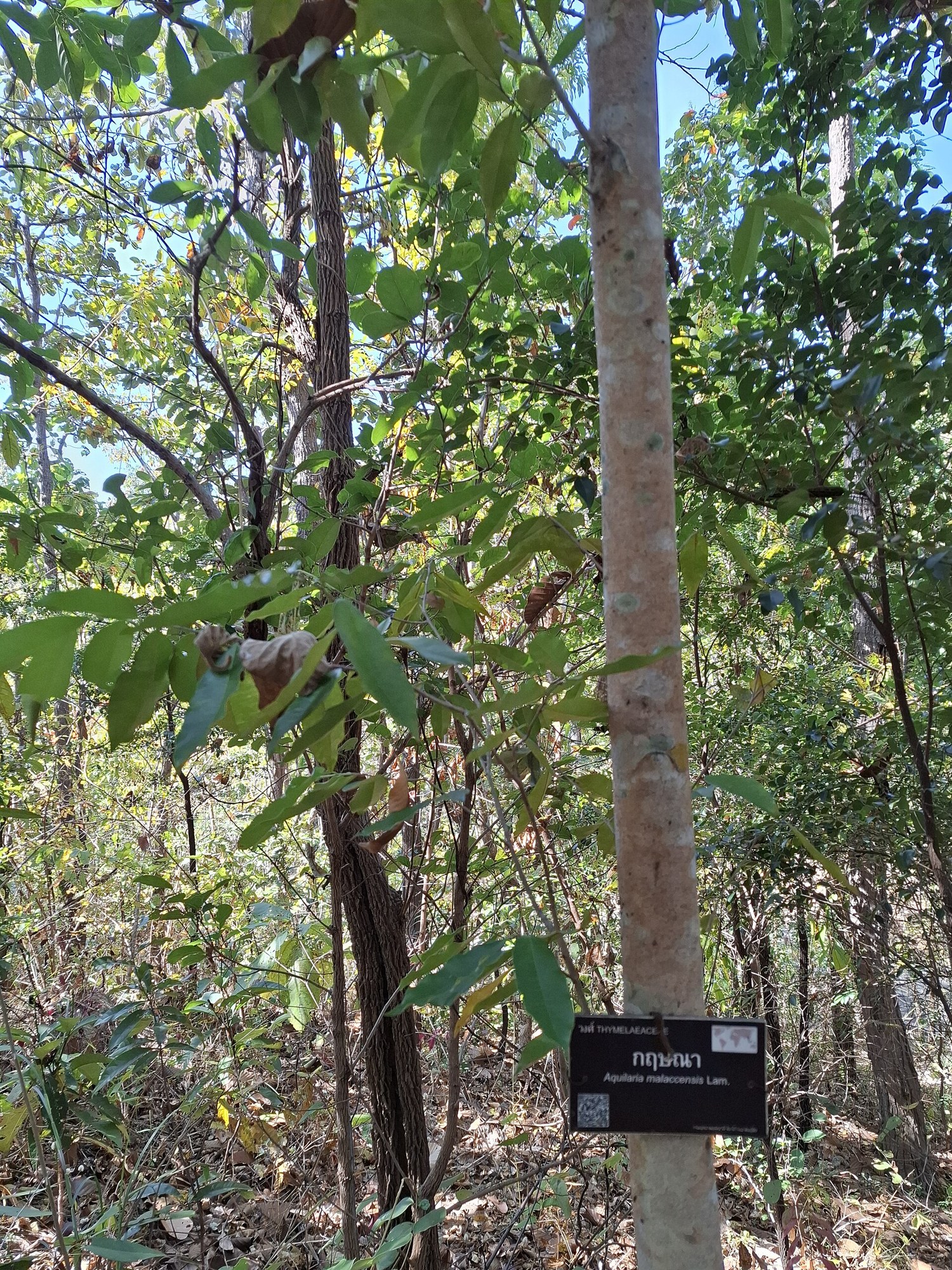
A healthy Aquilaria trunk is pale and nearly scentless. The material the trade calls gaharu, agarwood, aloeswood or oud is something the tree makes later, after the wood is opened and infected. The resin is a response of the living tree, produced in the timber only after injury [2, 4].
This long read stays with that fact. It follows how the resin forms, how the archipelago's trade took it up, and why wild Aquilaria malaccensis is now assessed as Critically Endangered and listed on CITES Appendix II. Its subject is history, biology, trade and conservation. The dictionary entry records the plant; this page records the wound, the market and the conservation record.
A tree of the wet forest
Aquilaria malaccensis Lam. is a tree in the family Thymelaeaceae. Plants of the World Online places its native range from Bangladesh to western and central Malesia [1]. In the Malay world the resinous wood is gaharu; the standing tree is often karas. Older trade names (eaglewood, aloeswood, ʿūd) sit beside those vernacular names and point to the same product: dark, fragrant heartwood formed after injury [2, 7].
The tree fills its trunk with resin only under particular conditions. Reviews of Aquilaria chemistry and induction are consistent on this point. Untouched wood carries little of the oleoresin that the market wants. The fragrant material appears when the trunk is wounded and fungi enter, and the tree lays down sesquiterpenes and chromones in response [2, 3, 4]. Shivanand and colleagues, writing in Molecules in 2022, put the mechanism in the title: the fragrant molecules of a wounded tree [2].
That is why a felled, healthy trunk can be almost worthless as incense, and why a small, dark patch in an old wound can be worth more than the rest of the bole. The trade deals in a pathological product, and timber is a different commodity.
What the tree lays down
The chemistry of agarwood is now described in some detail, even if the field still argues over which fungi and which wounds produce the best resin. Kristanti, Tanjung and Aminah reviewed the secondary metabolites of the genus: sesquiterpenoids and 2-(2-phenylethyl)chromones dominate the fragrant fraction [3]. Later work has followed how those compounds are induced, and how microbial infection and mechanical damage both sit in the pathway [2, 4].
Tan and colleagues, in Frontiers in Plant Science in 2019, surveyed induction methods used in plantations: deliberate wounding, inoculation with fungi, and combinations of the two [4]. The practical point is the same as the botanical one. Resin is produced after the tree is forced to respond, and a standing, uninjured tree carries only the pale wood. In the forest that response followed storm damage, borers or chance infection. In a plantation it is scheduled.
The papers describe plant chemistry and horticultural method, and this page keeps to the same ground: botany, trade and conservation.
Names that travelled
The product moved under many names before the scientific name settled. López-Sampson and Page, in their 2018 history of agarwood use and trade, trace the material through South and Southeast Asian records and into the long-distance incense trade [7]. The Malay gaharu, the Arabic ʿūd, and the older English aloeswood and eaglewood are names for the resinous wood, shared across many rituals and many markets.
John Crawfurd, writing in 1820 in History of the Indian Archipelago, already treated agila or aloes wood as a forest product of the islands, listed with camphor, benzoin and the spices that drew European ships east [8]. He was a colonial administrator, and his book records what the trade already knew: that a dark, scented wood left the forests of the archipelago and entered a market that stretched far beyond it.
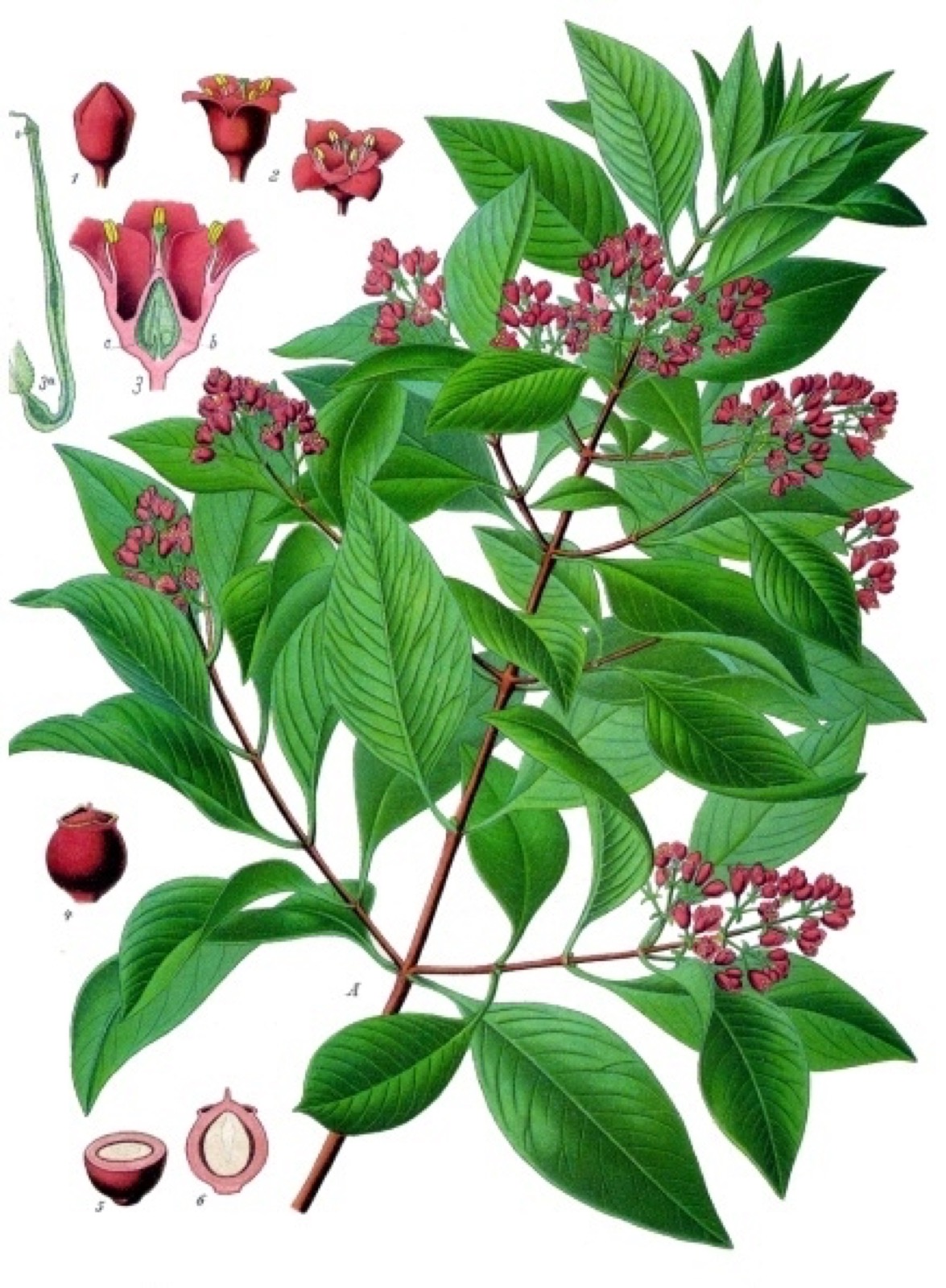
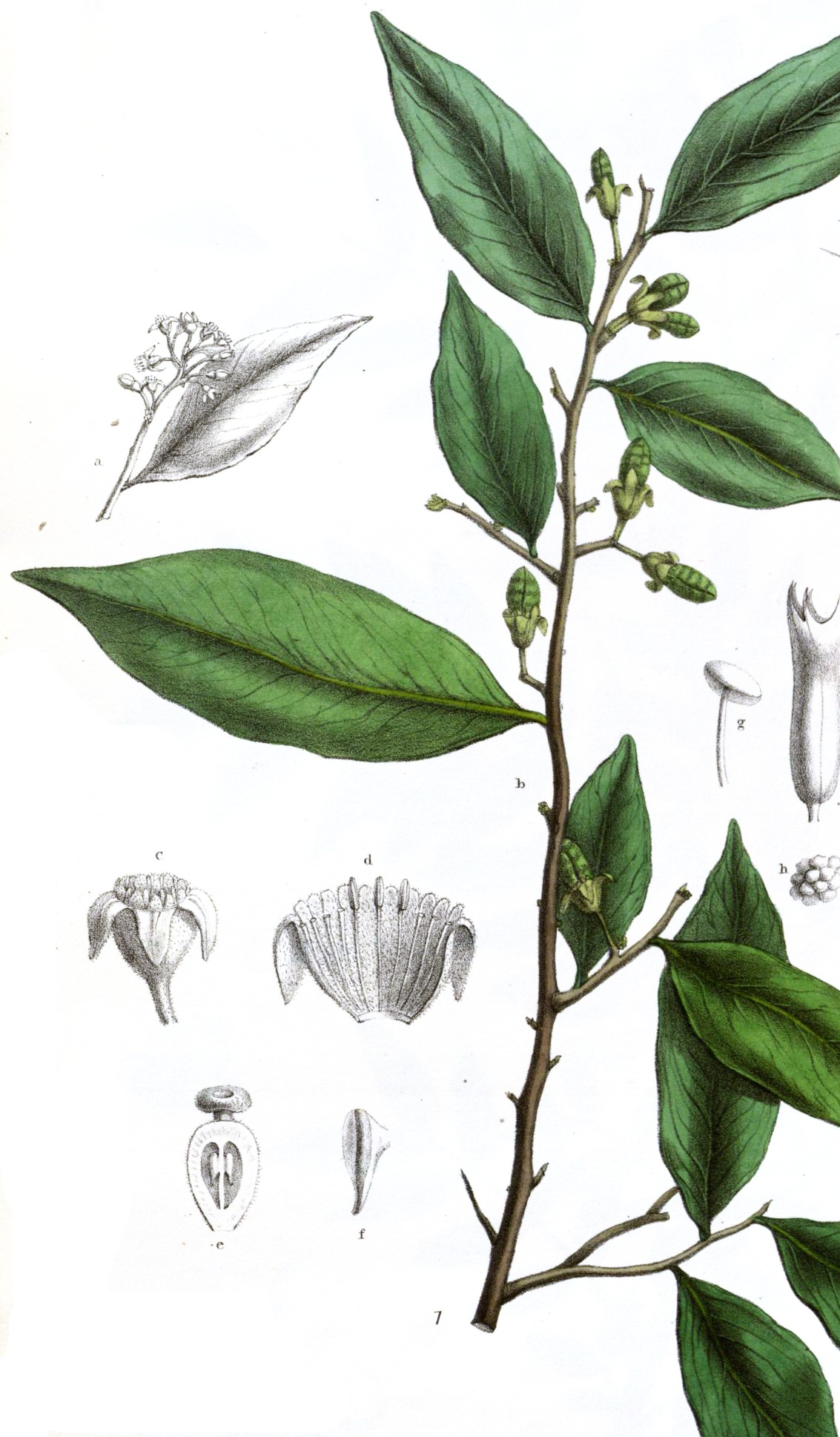
The dictionary entry keeps the scientific name to A. malaccensis and notes Agallochum malaccense as a synonym. Historical plates often use Aquilaria agallocha, a name the Royle plate still carries. That plate is the lead image here. It is a nineteenth-century botanical figure, a printed plate of the tree, and it shares its original sheet with an Astragalus. The crop used on this page is the Aquilaria half.
A high-value product, then a shortage
Modern reviews describe agarwood as a high-value fragrance material, burned as incense and used in perfumery, with a trade that is now global [2, 7]. They also describe the consequence. Overharvest of wild trees to meet that demand has made naturally formed agarwood rare [2, 4]. Trees were cut in the hope of finding resin, including trees that held only pale wood. A search that destroys the standing stock is a harvest beyond what the forest can absorb.
Tan and colleagues record the industry's reply: mass planting of Aquilaria, and the induction of resin in those planted trees, has become the main route to supply in several Asian countries [4]. Plantation wood is a different object from a wild, slowly formed piece. It is the form the trade can still legally grow. The wild tree is the one the Red List and CITES now address.
Critically Endangered, and listed
The IUCN Red List assessment for Aquilaria malaccensis, published in 2018 by Harvey-Brown, assigns the species Critically Endangered [6]. The assessment is dated, and it is the listing this site uses. A later assessment, if one is published, would replace it; until then the 2018 record stands [6].
CITES lists A. malaccensis on Appendix II [5]. Appendix II is a control on international trade: a permit system for specimens of species that may become threatened if trade is left unregulated. The practical effect for anyone moving gaharu across a border is documentation. The dictionary entry's trade note is the same fact in shorter form: plantation material, or material accompanied by CITES papers, is the documented route.
Those two listings, the Red List and the CITES appendix, are the conservation record this page can cite. National harvest rules exist in range states; this article leaves a compiled table of them to the entry. Where a national instrument is needed, it belongs on the entry once a dated source is in hand.
What induction leaves open
Plantation induction answers a market problem, and the wild population remains a separate question. Tan and colleagues describe methods and their limits; the review covers induction in plantations and stays with that scope [4]. Shivanand and colleagues, and the IUCN assessment, keep the wild tree and the traded product in view as two different things [2, 6].
A reader who wants the names, the range and the cited uses should read the gaharu entry. A reader who wants the neighbouring incense woods can move to kemenyan and cendana, or to kapur barus, another Bornean tree whose trade and conservation sit in the same historical current. Those pages are dictionary entries, and they carry sources.
The scent, described as scent
When the resin is heated, the smell is woody, then resinous, then balsamic, with a smoky edge on chips [see the entry]. Those words are sensory: a description of a scent in the room, set down as scent.
How a plantation tree is made to resin
Tan and colleagues group current induction methods into mechanical wounding, fungal inoculation, and combinations of the two [4]. The paper is a review of what growers already do. A nail, a drill, a strip of bark, or an inoculated hole is a way of repeating, on a schedule, the injury the forest once supplied by chance.
Two consequences follow, and both are in the sources already cited. First, supply can shift from wild search-and-fell to planted trees [2, 4]. Second, the product changes. A slowly formed wild piece and a resin induced over months in a plantation bole are both called gaharu in the market. They are different objects, and the papers treat them as different objects [2, 4]. This page follows that distinction and records both. It records that the wild tree is the one the Red List assesses, and that plantation wood is the form the trade can still grow under a permit system [4, 5, 6].
The chemistry reviews sit beside that horticultural work. Sesquiterpenes and 2-(2-phenylethyl)chromones are the fragrant fractions named in the genus review [3]. Later papers follow how those compounds appear after infection [2]. Figures for "how much resin a wild tree holds" or "how many wild trees remain in Malaysia" belong to dated surveys, and such surveys are the place to find them rather than recollection.
What Appendix II means
CITES Appendix II is sometimes read as a ban. The listing for A. malaccensis is a control on international trade: a permit is required to move specimens across borders [5]. Domestic harvest rules are a different instrument, and they sit outside this page. A reader moving chips, oil or carvings should read the current Species+ record, which is updated as listings change.
The Red List status is a separate judgement. Critically Endangered, 2018, Harvey-Brown, is the assessment cited on the entry and here [6]. The two systems answer different questions. One asks whether international trade needs a permit. The other asks how close the wild population is to extinction, on the evidence available in that year. Each is a record of conservation, and scent notes belong elsewhere.
The plate
The Royle 1839 figure used as the lead image is a printed botanical plate of Aquilaria agallocha, a historical name, drawn for a Himalayan flora and later reused as a reference image [see the credit]. It is in the public domain. It shows the tree as a nineteenth-century artist drew it, and the caption on the page says plate. The crop drops the Astragalus that shared the original sheet.
Reading the entry beside this article
The gaharu entry holds the names, the POWO range, the scent profile, the CITES and IUCN rows, the trade note, and the numbered references. This article is the long read that sits beside it.
A conservation collection, Forests under pressure, groups gaharu with kapur barus, periuk kera and bunga pakma. Those four entries are the record for that grouping.
What remains open
Several questions are still open in the literature this page uses, and they stay open here.
Which fungal partners, in which sequence, produce resin that matches the old trade grades is still a research problem [2, 4]. How much wild A. malaccensis remains in each range state, in what size classes, is a survey problem; the 2018 Red List assessment is the dated status, and a new census would update it [6]. How plantation wood should be described so that a buyer can tell induced resin from a slowly formed wild piece is a labelling problem the papers raise and leave open [2, 4].
This article records what the cited sources say: the fragrant wood is a wound product; the trade is old and now global; the wild tree is Critically Endangered; international movement is regulated. The rest belongs to the next assessment, the next survey, and the dictionary entry as it is updated.
Trade before the modern reviews
López-Sampson and Page's 2018 review is the trade-history source this page can name. It follows agarwood through written records of use and exchange, from South and Southeast Asia into the long-distance incense trade, and it describes the product as resinous heartwood, set apart from ordinary timber [7]. The paper is a historical survey, and this page reads it as one.
Crawfurd, a century earlier, put agila or aloes wood in a list of island forest goods beside camphor and benzoin [8]. The pairing is useful because it shows how a nineteenth-century observer grouped gaharu: with other scented exudates and woods, apart from kitchen spices. The botanical identity behind his trade name is the modern checklist's work. This page keeps POWO's A. malaccensis as the accepted name and reads Crawfurd as a record of the product, while POWO supplies the taxon [1, 8].
The two sources describe the trade in prose. A year-by-year export table for the Malay Peninsula or Borneo would come from a later customs series. The reviews in the reference list describe a high-value fragrance trade and a wild stock that was cut in the search for resin [2, 7]. That is the claim this page repeats, and it is the claim that leads to the Red List and to CITES [5, 6].
Chemistry, induction, and the limit of both
Kristanti, Tanjung and Aminah's genus review names the two compound classes that dominate the fragrant fraction: sesquiterpenoids and 2-(2-phenylethyl)chromones [3]. Shivanand and colleagues place those molecules in the wounded tree [2]. Tan and colleagues then describe how growers force the same response: mechanical wounding, fungal inoculation, or both [4]. The three papers sit in one line, and each is a work of chemistry or horticulture.
The induction review is also the source for a limit. Plantation resin answers a market that wild search can supply only by destroying standing trees [2, 4]. The Red List stands as published. Harvey-Brown's 2018 assessment is of the wild species [6]. A planted bole with an inoculated wound is a horticultural object. The papers keep those objects apart, and so does this page.
The chemistry papers cover compound classes and mechanisms. Resin yield per wild tree and a ranked list of fungal species that "make the best gaharu" belong to trade talk and to other studies, and the cited reviews leave them out.
A reader who wants the names, the range, the scent notes and the trade note should use the dictionary entry. A reader who wants the method behind a grade should use How we grade.